Wednesday, 25 May 2022

Old Musical Instruments

Did your ancestors play music? What kinds of instruments did they learn? Have you carried on these traditions?

I am a horn player, in particular a brass horn. I wrote about that in a blog post in April 2017 titled Music is in Our Blood. I took lessons from the age of about eight. For years in high school and after university graduation I play a valve trombone. I acquired it from my old music teacher and is a prized possession. Maybe one day I will get back to playing it.

But I have always been interested in antique instruments and how and when music was first played.

My daughter-in-law sent this link to me about a Glass Harmonica or Armonica (thank you Alice). I had not seen or heard one before. This YouTube video shows expert Dennis James demonstrating the instrument. Glass Armonica (spinning glass bowls... that break) - YouTube

They are amazing instruments that I learned go back hundreds of years. It was apparently invented by Benjamin Franklin in 1761. Musical tones are produced by friction from fingers sliding along the edges of glass bowls of different sizes and they spin. The instrument type is called a friction idiophone.

You can get the same effect using glass goblets partially filled with water to tune them.

Special music was written for these instruments, including by the world’s great composers like Wolfgang Amadeus Mozart (in 1791) and Ludvig van Beethoven (in 1814).

Glass armonicas were produced for public use through the 19th and 20th centuries, although not in great quantities. They still are produced commercially by G. Finkbeiner Inc. of Waltham, MA, a maker of glass lab ware. GFI Scientific glass blowing products and services (finkenbeiner.com)

Here is a video of Dennis James in concert: Adagio for Glass Harmonica, K 356, Wolfgang Amadeus Mozart (1756-1791) - YouTube

Musical instruments, of course, go back thousands of years. Every society and culture have had their own traditional types and styles.

·         Trumpets were found in Tutankhamun’s crypt (about 3,340 years old).

·         Flutes, made from bones may have been the earliest instruments used by humans specifically used to make musical sounds. Some found in China may be 9,000 years old. Other found in Europe go back 35,000 years. One found in Germany probably dates to 40,000 years and another in Slovenia is estimated at over 43,000 years.

·         Lithophones are made of rocks of varying sizes that produce sound when struck. Some found in India and Vietnam are estimated at between 4,000 and 10,000 years old.

·         Bullroarers are made of thin slats of wood attached to a stout cord and may go back to Palaeolithic times (18,000 years). When swung in a large circle they emit a roaring sound (thus the name). They have been found on every continent.

·         Blowing through holes drilled into conchs (seashells) have been known to produce sounds for about 18,000 years.

·         Stringed instruments may also go back several thousand years although they are only really known from about the 9th century.

Violins and their cousins date from the 16th century. The most famous is probably the Stradivarius, made by Antonia Stradivari (1644-1737). Their pure and unique tone is thought to be due, largely, to the dense and very fine-grained wood they were made from. During the colder years of the Little Ice Age, trees grew much slower, resulting in narrow annual bands. These materials (spruce, willow and maple) were thus more uniform in structure and more dense.

The Archangel Gabriel, of course, had a horn. That story would take us back several thousand years. If you would like to see an interesting sculpture of him, check out this video. Chocolate Angel - Bing video

Monday, 16 May 2022

Reminiscing

Every once in a while, you see a picture or hear a joke that reminds you of your childhood, or stories told by your parents or grandparents about their childhood.

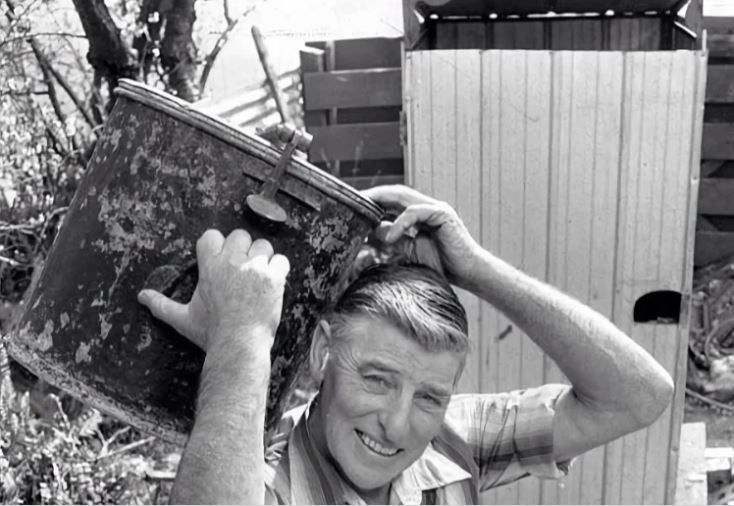
I sent out a funny pic recently, concerning the current leader of Russia, to friends around the world and got back a reminiscence from one about a Dunny Man. I had never heard the term before but apparently it is a term common to many parts of the world, or at least to places in the British Empire.

Chris noted that “Australians of my age affectionately remember the age of the ‘dunny can’, which would be positioned under a wooden seat in the ‘dunny’ (or out-house) and be collected weekly by the ‘dunny man’.  It was a true ‘poo tin’. I’m afraid the photo you posted, about a receptacle for dog droppings, does not capture the romance associated with our ‘dunny can’.  For example, my mum would always leave a generous Christmas donation for the ‘dunny man’, much more than she left for the garbage man, because she reckoned the ‘dunny man’ always looked cleaner. Whenever I couldn’t find mum, my day would say she had run off with the ‘dunny man’.”

So, of course, I did a Google search for the term. There are all kinds of stories and even books written about the subject. Blog posts too! Who knew?

For my part, I remember outhouses on my grandparents’ farm, and using the Eaton’s catalogue for toilet paper, but being a city kid, we always had indoor plumbing. The outhouses on the prairie were all built over deep holes that were filled in and a new one dug every few years. My dad used to tell stories of Halloween pranks involving pushing the outhouse back a yard or two to catch unsuspecting people out for a moonlight potty trip. I can't even imagine what that was like for those who might have been caught, although I suspect farmers were all too aware of what could happen. No, my dad would never have done such a thing!

Another friend in England told me this story: “I had a tough elderly aunt who lived in a listed cottage out in the Warwickshire countryside.  I used to spend holidays with her in the ‘60s and she had a dunny can as did most of her neighbours.  The lovely council eventually compromised on the medieval local situation and installed covered cesspits alongside the quaint old buildings but it was up to the owners to install proper toilet facilities!  Auntie Gert was a tireless worker for the Royal British Legion and would walk from house to house every year selling poppies.  One neighbour had had their ces-pit emptied but the workman had neglected to replace the cover and one year Auntie fell in on a dark night.  She clung to the edge by her fingertips for about an hour, calling out for help in the cold and dark until someone went into their kitchen to make a cup of tea and heard her!  She had to be taken to hospital to be cleaned and rested but she had the ‘shakes’ for the rest of her life.” Boy, who wouldn’t?

Funny how pics we see or jokes we hear now stimulate those of us who are mature enough to remember the "olden days" if the '50s can qualify. The closest I can come is having seen milk men with their horse-drawn wagons delivering daily dairy products. Back then the joke was who might have been the result of a liaison of moms and milkmen or whether a lady ran away with one.

Outhouses are still in use in many parts of the world, or at the summer cabin where sewer lines have yet to be extended. You can buy elaborate plans to build them or even DIY kits from companies like Home Hardware. Ready-made units are available to just hall away and set up. Often however, they are marketed as Storage Sheds or as environment-saving products.

For fun do a search for “outhouse kits” and look at the dozens of images that pop up. One site you might come up with is called Morning Chores.

Reminiscing adds many things to your own family history, events and stories you thought you forgot or that did not seem all that important. What we might remember growing up is part of the fabric of our own lives. And if you can recall stories your own parents told you of everyday life, that really adds important pieces to your ancestral mosaic.

Like Outhouses!

Thursday, 12 May 2022

Book Review - Sweetness and Power: The place of sugar in modern history

Following is a review of a book I read when writing my article about Work, Life & Family in the Industrious Revolution, published in the September 2021 issue of Family Tree (UK) magazine. The book is Sweetness and Power: The place of sugar in modern history, by Sidney W. Mintz. I thought readers of this blog might be interested.

This is not a new book. It was first published in 1985, but it has relevance even 36 years later, perhaps especially to family historians who are interested in how the world changed during the last 500 years and how those changes impacted their ancestors and society in general.

Sidney Wilfred Mintz (1922-2015) was an anthropologist whose research primarily centred around the people of the Caribbean, creolization and food. During his long career, he taught at both Yale University and Johns Hopkins University and was a feature lecturer around the world.

This book is about the importance of sugar in the transformation of the world’s economy and, of course, diet. Mintz describes the history of the commodity, from all sides of the industry from production to consumption, the resultant societal changes, and controls by political establishments.

Slavery was a major part of the production of sugar and the growth, processing and distribution of the product central to colonial development.

He discusses, among other important events, the intrusion of sugar into diets, particularly in England, and the ensuing disruption of eating habits, family member interactions and altered work patterns. Such changes were coincident with and impactful on families prior to and during the Industrial Revolution. As the publisher asserts, the introduction and prolific use of “sugar has altered work patterns, eating habits and our diet” right into modern times.

Sweet tea, for example, became a major part of the English diet and central to industrialization as it was a way to get high energy sustenance in relatively low volumes of drink, that was easily made, carried and consumed by factory workers. Is expansion transformed the workplace, home life, culture and society.

As Mintz said in his summary, “the track sugar has left in modern history is one involving masses of people and resources, thrown into productive combination by social, economic, and political forces that were actively re-making the entire world.”

The book is wonderfully readable, entertaining and informative.

Published by Penguin Books, ISBN 9780140092332, and available from many booksellers as well as online through Amazon.co.uk for £9.99 (plus applicable shipping costs) or £7.99 for the Kindle version (also available at varying prices from amazon.com, amazon,ca and amazon.com.au).