Thursday, 8 June 2023

What do we Know about the Medieval Warm Period?

I have written a great deal about the Little Ice Age (LIA) that lasted from about 1300 to 1850. It’s an important period for family historians as it encompasses most of the centuries during which a substantial number of records were created that assist us in identifying our ancestors. Prior to those years, documents that describe people are in short supply, especially regarding recording of their surnames upon which we base much of our family research.

In discussions about my articles and presentations, I get asked many questions concerning climate change: Where are we going? How warm could it get? What causes climate change? etc. The short answer to all of these is: No one really knows!

There are lots of theories, of course. But if we cannot predict weather more than a few days or weeks in advance, how can we predict climate change many decades in the future. Perhaps one way of understanding the current Modern Warm Period, and to put it into long-term perspective, is to look at what happened many centuries in the past, when previous warm climatic periods occurred.

Are areas around the world warmer now that they were during the 18th century? Yes, they are. Is warming proceeding still? Very possibly it is. Is the rate of such warming increasing? There the jury is still out as warming has been going on since at least the middle of the 17th century at a relatively constant rate. While there have been decades when temperatures rose at seemingly alarming rates, there were also years when it dropped significantly as well.

We can all accept that the world today is warmer than it was. What many people do not realize, though, is that it is not the first climatic period during which the Earth was very warm. Within just the last 10,000 years of human history, there have been at least six major warm periods, each period lasting several hundred years (Shepheard, 2018). These alternated with colder climatic periods.

Average near-surface temperatures of the Northern Hemisphere during the last 11,000 years based on analyses of the changes in 18O isotopes from Greenland ice cores; diagram demonstrates the alternating periods of warm (red) and cold (blue) that occurred throughout the Holocene Epoch; after Dansgaard et al, 1969

What is interesting in looking at the last 100 centuries is that there is a strong parallel between the warm and cold periods and the rise and demise of civilizations. During most of the warm periods average temperatures were high – estimated from scientific and archaeological studies to be much higher than today – and societies of those times flourished. During each of the cold periods: climate cooled, harvests often failed, famine was common and pressure on societal structures increased.

In the end major civilizations each collapsed, probably not coincidentally, as climate conditions worsened.

Of more particular note, we can learn about the effects of climate change and the present environmental conditions by reviewing what went on during the last warm phase, the Medieval Warm Period (MWP) which lasted from about 900 to 1300.

Overall, data is still too sparse and unevenly measured to conclude what temperatures were like during the past two millennia on a global or even hemispheric scale. Even for the relatively short period of the last 700 years, after the first instruments were invented to measure it, different parts of the Earth have shown different trends or anomalies, although the LIA is readily observed in all regions. The Northern Hemisphere shows a relatively steady temperature increase from the coldest part of the LIA in the late 17th century.

Composite temperature anomaly series (ºC) for North America, Europe, China and all the Northern Hemisphere, with reference to the period 1860-1959 (Modern Warm Period); source Bradley & Jones, 1993

Of necessity, scientists have had to use proxies to infer relative heat and cold for centuries before instrumental measurements were possible. Such elements include changes in oxygen isotopes derived from ice core samples, tree rings, fossil vegetation, corals, pollen, dinoflagellate remains, deep sea or lake sedimentary deposits and others.

Geological studies show how sea level fluctuated during the past several millennia. One recent article (Balco et al, 2023) concluded that the Antarctic ice sheet was likely 115 feet thinner thousand years ago and, through successive cold periods – the LIA being the last – thickened to the extent it is today. Over recent decades various studies have shown Antarctic ice sheets have occasionally shrunk in some regions but simultaneously expanded in others with the result that, overall, the ice shelves may now be larger than they were many years ago (Andreasen et al, 2023).

In a 2010 study which involved temperature reconstruction of the last two millennia, researcher Fredrik Ljungquist concluded that “[t]he highest average temperatures in the reconstruction are encountered in the mid to late tenth century and the lowest in the late seventeenth century.” These results are consistent with many other studies of climate although most have not used or compared the number of proxies of this study.

Estimations of extra-tropical Northern Hemisphere (90–30°N) decadal mean temperature variations (black line) AD 1–1999 relative to the 1961–1990 mean instrumental temperature from the variance adjusted CRUTEM3+HadSST2 90–30°N record with two standard deviation error bars (blue shading); source Ljungquist, 2010

Conditions of the MWP, particularly in Europe, featured higher overall temperatures and stable weather patterns over many decades. That resulted in expansion of arable land and population growth. Polar ice was rarely seen in the North Atlantic in contrast to during the LIA when ice packs often surrounding Iceland. Mountain passes in mountain ranges around the world were mostly free of ice, allowing frequent contact between communities and greater trade interactions. By 1300 almost all of Europe was part of an integrated and vibrant, international trading system doing business around the world.

Drought and famine were not unknown especially in those parts of the world where temperatures were very warm, and precipitation was very low. For example, Central and Western North America experienced several mega-droughts during the 10th to 13th century. Many indigenous societies disappeared or were forced to migrate away from homelands they had occupied for hundreds of years.

There were certainly droughts during the LIA, however, these were mostly resulted from lower precipitation levels over extended periods, not from excessive heat and evaporation. What rain did occur in many regions was often not sufficient to recharge aquifers or raise groundwater levels.

Left: Drought Area Index (DAI; percent area covered by PDSI < -1 each year) over time in the West as reconstructed by tree rings, both annual in pale brown and 60-year low-pass filtered in black. The dashed blue curves are two-tailed 95% confidence intervals for the latter. The red and blue lines are mean DAI for the MCA (ca. AD 900–1300) and the 20th century out to 2003, respectively. This record shows that the MCA (ca. AD 900–1300) was much more arid on average than the 20th century; source Cook et al, 2009; Right: gridded summer Palmer Drought Severity Index (PDSI), reconstructed for period 1146–1155; source Woodhouse et al, 2009

As the MWP came to a close during the 13th century major storms became more frequent, pummeling European coastlines in particular. These destructive events continued into the LIA period beginning in the 14th century.

Rising sea level, resulting from melting glaciers and polar ice during the MWP, had led to building of dikes and land drainage in the Low Countries of northern Flanders, Belgium, the Netherlands and Luxembourg to protect farming operations developed during the preceding decades. These would come under major attack by storms in the lead up to and early decades of the LIA.

The MWP was a time when societies advanced, population expanded, food production grew, and commercial ventures developed worldwide. Families became more prosperous and life spans increased. While records are sparser than in subsequent centuries, this is the time when genealogical studies can commence.

In the analysis of any area in which one’s ancestors lived it may be valuable to research what the climatic conditions were through scientific and historical studies. Going back decades before existing family records will also show conditions of the environment that perhaps attracted or kept families in the areas in which future generations lived.


References

Drought Atlases:

·         Old World – https://www.drought.gov/data-maps-tools/old-world-drought-atlas

·         North American – http://drought.memphis.edu/NADA/

·         Latin American and Caribbean – http://www.climatedatalibrary.cl/CAZALAC/maproom/Historical/index.html

·         Eastern Australia and New Zealand – http://drought.memphis.edu/ANZDA/

Andreasen, Julia R., Anna E. Hogg & Heather L. Selley. (2023). Change in Antarctic ice shelf area from 2009 to 2019. The Cryosphere, 17 pp. 2059-2072. https://tc.copernicus.org/articles/17/2059/2023/tc-17-2059-2023.pdf

Balco, Greg, Nathan Brown, Keir Nichols, Ryan A. Venturelli, Jonathan Adams, Scott Braddock, Seth Campbell, Brent Goehring, Joanne S. Johnson, Dylan H. Rood, Klaus Wilcken, Brenda Hall & John Woodward. (2023). Reversible ice sheet thinning in the Amundsen Sea Embayment during the Late Holocene. The Cryosphere, 17 pp. 1787-1801. https://tc.copernicus.org/articles/17/1787/2023/

Bradley, Raymond S. & Philip D. Jones. (1993). Little Ice Age summer temperature variations: their nature and relevance to recent global warming trends. The Holocene, 3(4), pp. 367-376. http://www.geo.umass.edu/faculty/bradley/bradley1993b.pdf

Cook, Edward R., Richard Seager, Richard R. Heim Jr., Russell S. Vose, Celine Herweijer & Connie Woodhouse. (2009). Megadroughts in North America: placing IPCC projections of hydroclimatic change in a long-term palaeoclimate context. Journal of Quaternary Science, 25, pp. 48-61. file:///F:/Downloads/2009_Cook_IPCC_paleo-drought%20(2).pdf

Dansgaard, W., Johnsen, S. J., Moller, J. (1969). One thousand centuries of climatic record from Camp Century on the Greenland Ice Sheet. Science, 166(3903), pp. 377-381.

Lungqvist, F. C. (2010). A new reconstruction of temperature variability in the extra-tropcial Northern Hemisphere during the last two millennia. Geografiska Annaler, Series A92, pp. 339-351. https://cp.copernicus.org/articles/8/765/2012/cp-8-765-2012.pdf

Le Roy Ladurie, E. (1967). Histoire du Climat depuis l'an mil. Flammarion, Paris. (translated by B. Bray as Times of Feast, Times of Famine: A History of Climate Since the Year 1000, Doubleday and Co., 1971).

Shepheard, W. Wayne. (2018). Surviving Mother Nature’s Tests: The effects climate change and other natural phenomena have had on the lives of our ancestors. St. Agnes, South Australia: Unlock the Past, 179 pp.

Woodhouse, Connie A., David M. Meko, Glen M. MacDonald, Dave W. Stahle & Edward R. Cook. (2010). A 1,200-year perspective of 21st century drought in southwestern North America. Proceedings of the National Academy of Sciences (PNAS), https://www.pnas.org/doi/full/10.1073/pnas.0911197107

Tuesday, 9 May 2023

Reading Samuel Pepys’ Diary

Genealogists researching their London ancestors will find the diary of Samuel Pepys (1633-1703) of great interest and value. I am currently working my way through the entire book and getting an appreciation of the people and events of the period about which he wrote.

The book is a unique collection of observations of someone who lived in London and relates Pepys’ daily experiences with people (family, friends, work cohorts, politicians and regular citizens), the Great Plague of London, the Second Anglo-Dutch War, the Great Fire, local weather and other normal and not-so-normal events that transpired between 1660 and 1669. Pepys was just 26 when he started recording his thoughts. His observations span the last year of the Interregnum and the early years of the Restoration and reign of King Charles II.

The original diary along with other artifacts and manuscripts collected by the man are preserved in the Pepys Library at Magdalene College, University of Cambridge.

Various versions of the diary in book and digital format can be purchased from many retailers or read and downloaded directly from Internet Archive or through Project Gutenberg. For background, it is worth looking at both webpage sets.

The diary was originally written in Pepys’ own shorthand which has challenged people to transcribe it. The 1893 published version by Rev. Mynors Bright was a tremendous accomplishment in making the complete record available for everyone to be able to read.

I started reading the diary while researching information about the plague of 1665-66 and about the local weather during this period of the Little Ice Age. It is an invaluable resource for information about the epidemic and surrounding events and the people in London during the late 17th century. His experiences in moving around London during the height of the infection brings home the fear residents felt, the precautions they took to avoid catching it, how efforts were made to handle the sick and dying and some of the horrible, daily scenes witnessed. He also quotes weekly statistics of deaths which makes the publication a good reference source.

Samuel Pepys served as a clerk and administrator in the Royal Navy, rising to become Chief Secretary to the Admiralty. He was elected to Parliament in 1673. The diary provides first-hand glimpses into the lives of Londoners during the Restoration almost from the time Pepys began his working life until what he believed was failing eyesight forced him to halt his writing. The affliction turned out to not be true. No doubt our knowledge of British history would be much greater had he continued to document his experiences until his death in 1703.

In addition to Pepys’ own recollections and records, the book also has considerable background history about his family as well as the (notable) people with whom he came in contact as friends and work colleagues. Incorporated into the digital text provided by Project Gutenberg are many editor’s notes explaining who various people were and what events were occurring that were referenced by Pepys.

Pepys’ writing contains many personal comments about his own life. One of the early notes from 3 January 1660, gives us a peek into that day’s activity that would be a preview of what comments about future days would be like:

I went out in the morning, it being a great frost, and walked to Mrs. Turner' s to stop her from coming to see me to‐day, because of Mrs. Jem' s corning, thence I went to the Temple to speak with Mr. Calthrop, and walked in his chamber an hour, but could not see him, so went to Westminster, where I found soldiers in my office to receive money, and paid it them. At noon went home, where Mrs. Jem, her maid, Mr. Sheply, Hawly, and Moore dined with me on a piece of beef and cabbage, and a collar of brawn. We then fell to cards till dark, and then I went home… and there found Mr. Hunt and his wife, and Mr. Hawly, who sat with me till ten at night at cards, and so broke up and to bed.

From July 1660, Pepys’ home was in the Navy Office buildings on Seething Lane, near The Tower of London. Pepys, of course lived in the city during the last major plague of 1665-66. None of his family were infected but he does comment on many of his friends who succumbed such as this comment on 25 August 1665:

This day I am told that Dr. Burnett, my physician, is this morning dead of the plague; which is strange, his man dying so long ago, and his house this month open again. Now himself dead. Poor unfortunate man!

Samuel often mentioned the weather conditions, probably as his travels around the city were mostly on foot. And without the modern conveniences of air conditioning or central heating, people were much more attuned to the temperature and precipitation (or lack thereof) around them. Still though, many comments are not unlike one might today or at any time over the past centuries. These contrasting entries are typical of his observations:

6 February 1665 – this being one of the coldest days, all say, they ever felt in England

7 June 1665 – it being the hottest day that ever I felt in my life, and it is confessed so by all other people the hottest they ever knew in England in the beginning of June

18 March 1666 – very fine fair weather, but all cry out for the lack of rain

1 January 1667 – being a bitter, cold, frosty day, the frost being now grown old, and the Thames covered with ice

7 March 1667 – this day was reckoned by all people the coldest day that ever was remembered in England

27 July 1667 – it having not rained, I think, this month before, so as the ground was everywhere so burned and dry as could be; and no travelling in the road or streets in London, for dust

The location of Pepys’ home was very fortunately just outside the area that was consumed during the Great Fire in 1666. Pepys makes many comments about the fire, the people who fought it and those who were impacted by it in losing their homes and businesses such as this on the day it started – 2 September 1666:

So down, with my heart full of trouble, to the Lieutenant of the Tower, who tells me that it begun this morning in the King' s baker' s' house in Pudding‐lane, and that it hath burned St. Magnus' s Church and most part of Fish‐street already. So I down to the water‐side, and there got a boat and through bridge, and there saw a lamentable fire. Poor Michell' s house, as far as the Old Swan, already burned that way, and the fire running further, that in a very little time it got as far as the Steeleyard, while I was there. Everybody endeavouring to remove their goods, and flinging into the river or bringing them into lighters that layoff; poor people staying in their houses as long as till the very fire touched them, and then running into boats, or clambering from one pair of stairs by the water‐side to another.

Whether or not you have ancestors in the London area, the diary is a must read to gain insight into how locals viewed what we now regard as important history of late 17th century England.

Thursday, 23 March 2023

A clerical error or were they lying?

In the preparation of an article I am writing, I have been looking at the history of a particular family. One of the individuals was a woman by the name of Doris Fisher. She was the first-born of a couple by the names of James Fisher and Minnie Elizabeth Buckland.

Before I get to Doris, I would note that James was actually James John, but on almost every document I have found he did not use his second name. Being a relatively common name, it led to some complicated searching to figure who he was and to what family he belonged. His birth registration filed in 1854 shows his full name. So does his baptism record, however, he was not baptized until 1872 which added to the complexity of the search.

On every census, voters list, birth and baptism records of his children, and even on his marriage record James John was shown as just James. On his 1927 death certificate his full name was finally recorded again. One of the things that allowed me to identify him was his occupation. For most of his life he was a builder / decorator. From that and the names of his children I could track him around southeast England as he obviously moved to find work in developing communities.

Doris was born in 1890. Her birth record shows just “Doris” but her baptism record has Doris Isabel. The second name was important in finding her on subsequent documents. She was living at home with her parents in 1891 when the census for that year was taken but disappears from family records afterward. I thought for a long time she might have died or emigrated, but I could find no death or passenger record to confirm either scenario.

A 1928 passenger list recorded her mother, Minnie E. Fisher, on her way to Canada, to join with a son, Mr. H. Fisher (Harland), who lived in Vernon, British Columbia. There was also a note that her nearest relative left behind was a daughter, Mrs. D. Wood, of 375 Harold Road, Hastings, Sussex. The address was the family home for many years and the person I thought could only be Doris. Now the challenge was to find when she married and what his name was.

The search led me in circles, though. Voters lists for Hastings for 1929 showed both Minnie Elizabeth Fisher and Doris Wood living together at 375 Harold Road. This list post-dated when Minnie left the country which is not unusual as it can take a while for civil record administration to catch up. By 1930, Doris, now shown as Doris Isabel Wood, had moved to another location in Hastings. Interestingly, Doris’s husband was not shown on any voters list with her indicating they had separated or even divorced.

I wondered if she had died in Hastings and when. The death record might give me some information on her family connections. A search on FreeBMD found only one person who fit her age and location: Doris Wood, age 60, died in 1951, in Hastings. I took a chance and ordered the record from the General Record Office. On the certificate her usual residence was 69, Southwater Road which was the same as on the voters list; her husband was George Wood, kennelman; and the informant was her son, L. P. A. Wood, living at the same address as Doris.

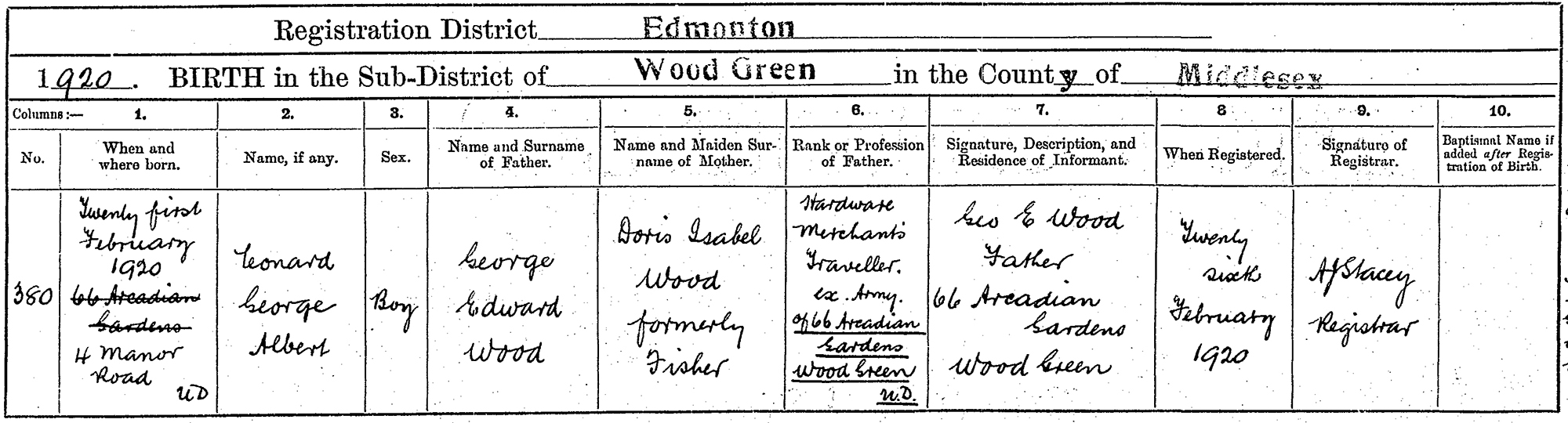
Now I had another name to look up. So, I did. Leonard George Albert (not L.P.A. as Doris’s death record had stated) was born in 1920 in Wood Green, Middlesex to parents George Edward Wood and Doris Isabel née Fisher.  

In later years, Doris was found on voters’ lists and the 1939 register living with her son, Leonard, in Hastings. Leonard served in the military during World War II but returned to Hastings after it was over to again live with his mother until her death in 1951. It appears he never married.


The family was also found on the 1911 census, living at 30 Guildford Road, Brighton, Sussex. They had been married less than a year then. With them were Charles Wood (b. 1868-69) and Emily Frowd Wood (b. 1866-67). All of them were indicated to be Visitors. But were they related?

I had found most of the information related to the Fisher family. The rest of the Wood family was to be a bit more complicated.

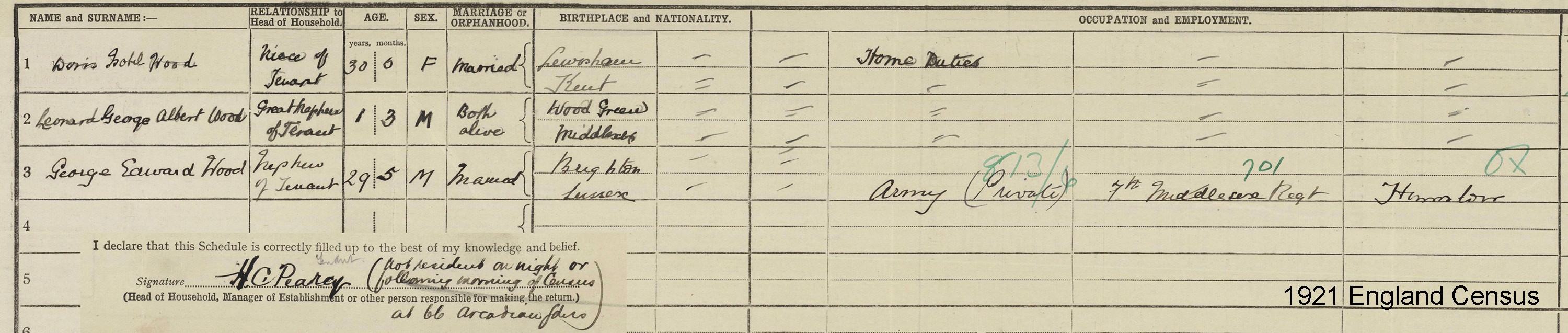
The 1921 census stated that Doris, George and Leonard lived in a residence belonging to H. C. Pearcy. In 1911 Henry Charles Pearcy (b. 1873-74) and his wife Martha Alice (b. 1875-76) lived with Annie Wood (b. 1841-42), who was the “wife’s mother.” Their address of 48 Pellatt Grove, Wood Green, Middlesex was also the address shown on the 1909 marriage for Charles Valentine Vickers Wood (b. 1868-69) and Emily Frowd Keevil (b. 1862-63).

One of the witnesses to the nuptials was Alice Pearcy, very likely Charles’s sister. That seemed to establish connections between George Edward Wood, Charles Wood and the Pearcys. Was George a son, a nephew, or what?

The family of Charles Valentine Vickers Wood (b. 1836-37, d. 1879), from results of searches of censuses and other records, included parents Valentine Vickers and Annie (Woodall) Wood (b. 1841-42) and their children, Annie Jane (b. 1862-63), Martha Alice (b. 1863-64) and Charles (b. 1865-66). Charles’s 1950 death record has his age at 86, suggesting a birth year of 1863-64. We had our Wood family then. Given their unusual names it is hard to argue that Charles and Emily are not the same people on the several documents even though their recorded ages differ.

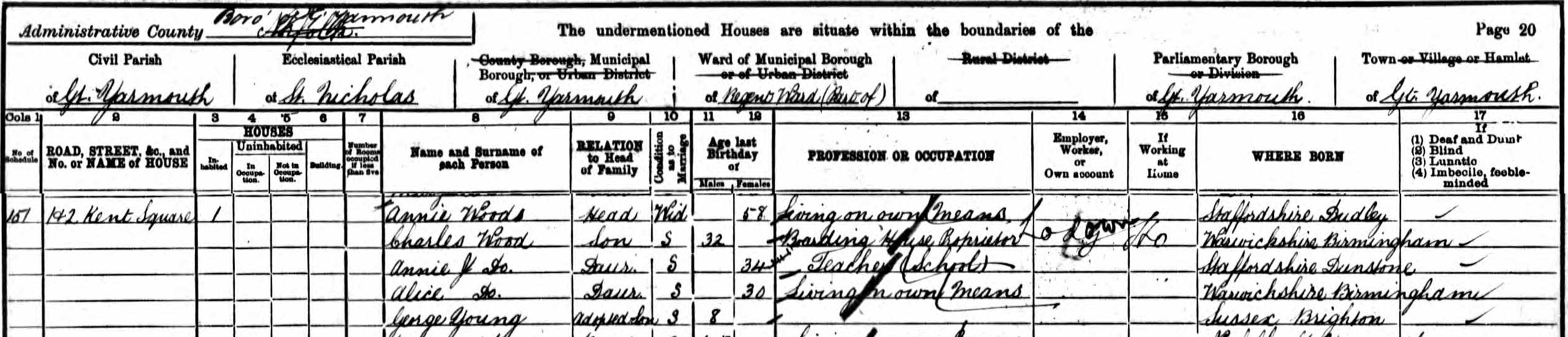
Census records have a variety of ages for the Wood children. On the 1881 census, Annie Jane’s birth year was shown to be 1863-64, Martha Alice’s was 1864-65 and Charles’s was 1865-66.  On the 1901 census, there is a family headed by widow Annie Wood (b. 1843), living in Great Yarmouth, Norfolk, with children Charles (b. 1868-69), Annie J. (b. 1866-67) and Alice (b. 1870-71). Their birthplaces match most other records even though their ages do not. Some liberties appear to have been taken relative to the birth dates. Also on this census record is a George Young (b. 1892-93) an “adopted son.”

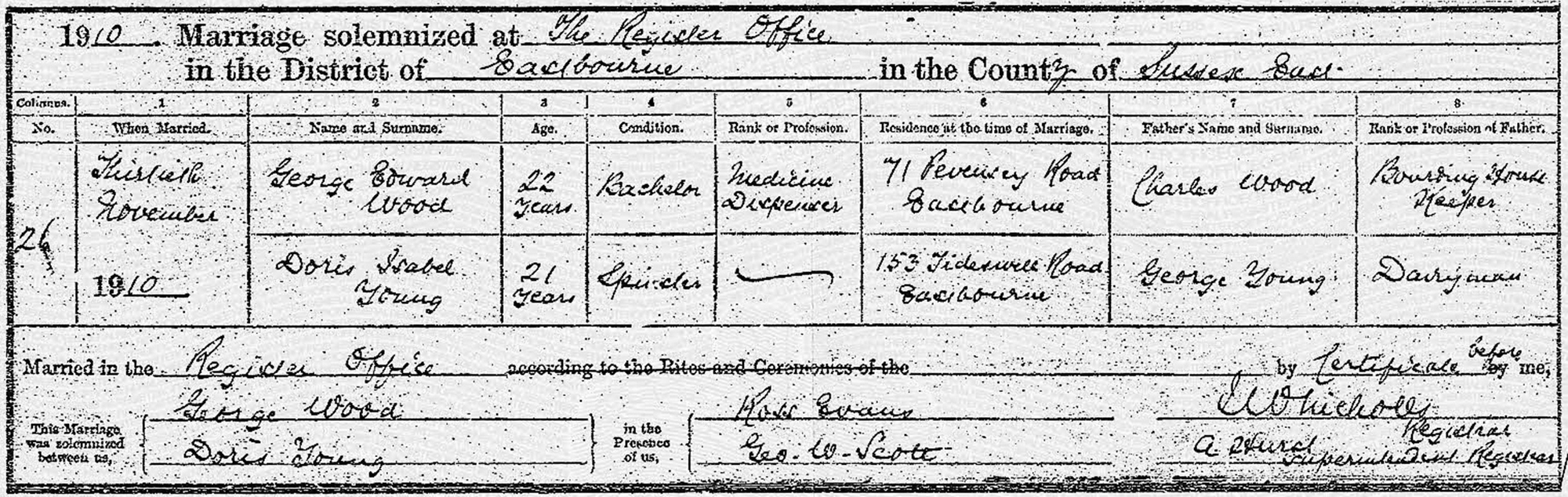
Now I came to a dilemma. Or was it a fabrication? The only marriage record I could find was dated 30 November 1910 between George Edward Wood and Doris Isabel Young. His father was shown as Charles Wood and hers as George Young. The relationship with Charles could have right, but the name of Young appeared to be totally wrong, given other information from the 1911 and 1921 censuses and the 1920 birth record of Leonard Wood.

Was George Edward Wood actually George Young, the adopted son of Annie Wood? The age matched and the name shown on the marriage record was curious.

George was very likely not the 22 years of age (b. 1887-88) shown on the marriage certificate as most other documents show his birth around 1892. With George being underage, it might have led the couple to take liberties with the truth and marry in the register office rather than in a local church. He was recorded as being 20 on the 1911 census (b. 1890-91) and 29 on the 1921 census (b. 1891-92). So, there was a pattern of growing younger as he aged.

Was there a clerical error made when the marriage record was filled out or did George and Doris conspire to give wrong information. The fact that Doris signed as Doris Young suggests the latter.

I am not sure we will ever know the true facts.