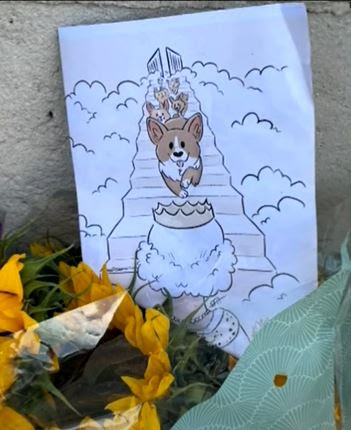
Tuesday, 13 September 2022

The Queen is dead. Long live the King.

As the last several decades have unfolded, many of us wondered if we would ever hear those words. Especially those of us who have lived through the entire reign of Elizabeth II.

I was one of those who watched the broadcast of her coronation live on television. Our household was one of the few in our neighbourhood that had a TV, mostly because my father was in the business of selling and servicing them.

In the next few days and weeks, we will hear commentators and others proclaim the attributes of this monarch who served (not a word to be spoken or taken lightly) with grace and dignity and with the highest sense of duty, to her country and to the world of the Commonwealth of which she was the head.

She did not have the luxury of choice in her career. She was also not born into it but was elevated to the role on the death of her own father. And at a very young age for the responsibility the position would entail. She did her job, though, with a gentle but unswerving strength that has enthralled millions around the world. Few praises will do justice to her dedication and success.

In hearing and seeing the tributes from her family, though, it struck me more about how they had lost a mother and a grandmother. For those outside of her immediate family many of us will feel we have lost someone special as well.

And we will remember how we felt when we lost our mothers: the sadness, the emptiness, the knowledge we would no longer have that important person to share our lives with. We have memories though, for the time they were with us, as will Queen Elizabeth’s family.

My wife’s mother almost reached 90 years of age so our children well remember her and the things they did with her. My mother did not reach even 60 years. My sisters and I have fond memories growing up but our children did not get to know her.

You never know how long your mother will be around. The Queen’s family is fortunate to have had her in their lives for as long as they did. As are her siblings and their families. Their family photo is certainly more regal looking than ours, but in the end, it is still a picture of a family with its unique persons and personalities, all joined by a bond similar to all families. 


Thursday, 8 September 2022

FHDU 2022 Conference

 I am pleased to announce that I will have two presentations at the upcoming FHDU 2022 conference. That’s Family History Down Under for those who are not familiar with what is happening on the other side of the globe.

Both my talks have been pre-recorded since it is too far for me to travel these days. The conference organizers were supportive of having my contributions online. One is actually already available to attendees.

My presentations:

Natural Phenomena and Their Effects on Our Ancestors – The presentation will offer a perspective on how natural events and conditions of the physical environment controlled the lives and livelihoods of people in the past.

Using Parish & Other Records…to determine what and how certain natural events affected people and communities in the past – The presentation will involve a discussion of what types of information are available that show how natural phenomena impacted lives and livelihoods using specific examples of records and areas.

Here is the latest release from the conference about the program and the event.


FAMILY HISTORY DOWN UNDER 2022

A world-class family history conference with in-person and virtual options

Adelaide, South Australia, 8 September 2022
Unlock the Past is delighted to announce that Family History Down Under 2022 (FHDU 2022) is now just two months away. The 4-day in-person conference will be held 8-11 November 2022 at Castle Hill, near Sydney. Two virtual options bring FHDU 2022 within reach of anyone, wherever they are, who cannot join us at Castle Hill.
Overview
There will be four main themes or tracks – DNA; Researching Abroad; Australia & New Zealand; Methodology & General. Choose from 70+ presentations from 35 presenters from seven countries, plus 11 workshops and two conference dinners. The exhibition, which is both in-person and virtual, offers big savings from sponsors and exhibitors. And around AU$12,000 in prizes will be up for grabs. The FHDU 2022 Community (a private Facebook chat group) will be available for interaction between attendees, speakers and sponsors. All presentations, except workshops and conference dinner talks, will be available for all attendees (in-person and virtual) to view until 28 February 2023.

Venue
Castle Hill RSL Club is a fantastic venue. It is close to Sydney, Australia’s largest city, with access via Sydney Metro Northwest rail, onsite parking and plenty of accommodation nearby. It has multiple large capacity conference rooms and multiple lounges, bars and dining choices for these who would like to gather after each day’s program.


Unlock the Past / Family History Down Under
Unlock the Past is the event and publishing division of Gould Genealogy & History (established 1976). It is a collaborative venture involving an international team of expert speakers, writers, organisations and commercial partners to promote history and genealogy through innovative major events and publications. Recent events have been DNA Down Under and Family History Down Under 2021.

Family History Down Under 2022 — our final event
It is now time to call it a day!  Since 2003 we have organised around 150 events — expos, conferences, roadshows, 17 genealogy cruises, Australia’s first significant battlefield tour, seminars and more. FHDU 2022 will be our final event.

I hope you will join us at Castle Hill, or virtually, for one last farewell event in November 2022. Find out more at www.fhdu22.com.

Monday, 18 July 2022

More About River Erosion & Sinking Coastlines: Jamestown Colony Site

In a post on my blogsite, Mother Nature’s Tests, I wrote about the Drought During the Establishment of Early American Colonies. Well, those sites have a new problem caused by Mother Nature. They are in danger of erosion by the James River and flooding by the shift in sea level.

Many people would have us believe that climate change is causing ice caps to melt and sea level to rise. That may be partly true but what is really happening on the east coast region of the United States, and elsewhere in the Northern Hemisphere in regions next to where the Pleistocene ice cap existed, is that the land is sinking, making it appear as if the sea is rising.

During the last ice age, thick accumulations of ice depressed the Earth’s crust causing it to sink into the mantle on which it is “floating” to maintain static equilibrium (isostasy). That resulted in the viscous mantle being forced away from the ice sheet resulting in lands along the perimeter of the glaciers to rise. When the ice sheets melted, the reverse processes occurred with the mantle material adjusting to its pre-glacial state: the lands under the glaciers rose (isostatic or post-glacial rebound) and the lands adjacent started to sink. This is shown on the diagram below.

The coastal region from Newfoundland in the north to North Carolina in the south and then west to the Pacific Ocean is currently still sinking as the mantle flows back toward Canada. The rate of downward vertical movement is up to mm per year.

One can see the results of rebound in the Canadian Artic region. It is clearly indicated in areas where beaches such as those along Bathurst Inlet (below) march toward the ocean, each getting younger.

Along the eastern seaboard of the United States the shoreline is advancing landward as the relative sea level rises. The sedimentary strata, for those interested in the geological conditions, shows a vertical sequence of marine sediments overlying shoreline deposits which in turn overlie nonmarine deposits. This is called a transgressive sequence.

A significant effect of the landward migration of the shoreline is observed in the destruction of infrastructure when major storms attack the coastal areas. Houses that were at one time well inland now find themselves nearer to the ocean and are destroyed by hurricanes that make landfall nearby. The aerial photo below shows the damage inflicted on a row of homes (outlined in red) at Nags Head, North Carolina, by a 2009 storm. The position of the shoreline back to 1849 are indicated. The shore will continue to move inland as the land continues to sink.

When the Jamestown colony was established in 1607, the region was in the middle of the worst drought in over 700 years. The conditions resulted in poor to non-existent crops over the next few years. By 1610 it had been abandoned.

Today the sea is relentlessly advancing on the area where the colony was located. The water of the Chesapeake Bay region has risen about 1 ½ feet over the past 100 years. Jamestown Island in less than three feet above the waters of the James River. Eventually, the site on Jamestown Island will be taken over by the river and the rising groundwater.