Tuesday, 14 September 2021

My Parents’ Resumes

An interesting exercise that brings together some family information might be to write a resume for parents or grandparents or for individuals even further back.

Many of us have used resumes or curriculum vitae to show prospective employers what our education, background or work experience was (or is). Over the years, of course, these documents got bigger and contained more detailed information about jobs held or projects worked. Now they provide a great summary to show family members what we did to support our families.

If you don't have a resume your parents wrote, try to do it yourself with data you may have in your files.

You may be fortunate to have photographs of parents, etc. taken at their workplaces, perhaps with co-workers. You might have old tax returns that show how much they earned or how long they were employed in a particular position. Perhaps they obtained patents for designing implements or processes important in their line of work. That would be a valuable piece of information to include.

Serving in a country’s armed forces would be an important part of a resume. If you have or can get a copy of someone’s service record, you will find a great deal of information about when and where they were posted, what their responsibilities were and how they were seen by commanders. I have obtained several military service records for family members on both sides and, using information in the summaries written blogs posts and articles that showcased their participation and added significantly to the histories of our families.

Education is the first piece of information necessary for writing a resume. The various levels or degrees attained will show what direction or career a person was to follow.

If you have copies of certificates awarded from educational institutions, they will give you a great start in putting together a resume. Perhaps there are class notes or project summaries among your family’s memorabilia that illustrate what they did in school.

I have the original report cards and other information for my wife and me, and for all our children. Again, this data adds a great deal to our family history. Our descendants may find the material of great interest and they ponder what went on in the olden days.

I keep copies of business cards used by me, my wife and my children that, when put together, show work history and achievements as people moved up the management or responsibility ladders and/or changed employment. You may have letters from employers offering jobs or giving recommendations to future employers.

Some people may have published articles related to their work or expertise, including post retirement hobbies (In my case. I have a long and growing list of these.). Newspaper articles may summarize work achievements, promotions or new positions or advertise presentations given or scheduled.

Participation with service or other clubs show how a person is/was active in a community. These are things that may give an employer a good idea about what kind of person a prospective employee may be as well as what interests they may have.

An obituary may summarize a person’s career so these should be checked.

All this information is what may be incorporated into a resume.

Looking over my own resume one will see a multitude of companies for which I worked or provided consulting services to. Some positions were not of very long duration and you could get the impression I could not hold a job. My story is that there were always more challenges, with other companies that enticed me to move as well as a few situations – corporate and personal – that arose that led to my moving. I will say, though, that not all moves were great decisions on my part. I look back now and wonder why I made those decisions to change direction.

Writing resumes is much like writing family histories although for ourselves they must be current. Resumes, though, mainly concentrate on work or employment, not on any of the family or personal information that is part of complete family histories. Still, it is worth looking through old correspondence, school records, income data, photo albums to find information about how people spent their workdays.

Today you can go online to find many different templates for writing resumes. Or choose from a multitude of books that will show you how. They show you how to organize and lay out a document but also list what types of information will be useful and necessary to include.


Shown below are brief resumes for my parents from information gleaned from personal documents and photo albums. I will continue to add to these summaries as I find more information


Work History for William Calvin Shepheard (b1914-d1963)

Education

1928-1929       Olds School of Agriculture

1931-1932       Public High School – Kathryn Rural High School – Alberta – Matriculation

1936                Coyne Electrical School – Chicago, Illinois, USA

1945                No. 1 Wireless School R.C.A.F. – Calgary, Alberta


Employment

1939-1943       Hudson’s Bay Company         Radio & Refrigeration Service

1943-1946       Royal Canadian Air Force      Leading Aircraftman

1947-1952       Hudson’s Bay Company         Radio, TV & Appliance Service

1953-1955       Shepheard Electronics Ltd.    Radio, TV & Appliance Sales & Service

1956-1959       Sacker Electronics Co. Ltd.    Radio, TV & Appliance Sales & Service

1963-1968       Shep’s Service (Proprietor)    Radio, TV & Appliance Sales & Service

1968-1971       Hillhurst Electronics   Radio, TV & Appliance Service

1971-1983       Quilchena Golf Course           Golf Course Proprietor


Hobbies, Memberships & Service Clubs

Kiwanis Club

Calgary Motion Picture Club


Work History for Norma Mabel (Miller) Shepheard (1917-1974)

Education

1937    Department of Education – Calgary, Alberta – Interim Second Class Certificate,

Teaching         

1939    Department of Education – Calgary, Alberta – Professional Second Class Certificate,

Teaching

1962    Department of Education – Calgary, Alberta – Permanent Second Class Certificate, Teaching

1963-1970       Calgary School Board – Calgary, Alberta – In-Service Training Certificates


Employment

1938-1939       Lake Thelma School   Elementary School Teacher

1956-1959       Sacker Electronics Co. Ltd.    Office Administration

1963                Northmount Kindergarten      Kindergarten Teacher                                                

1963-1971       Brentwood Kindergarten        Kindergarten Teacher


Saturday, 11 September 2021

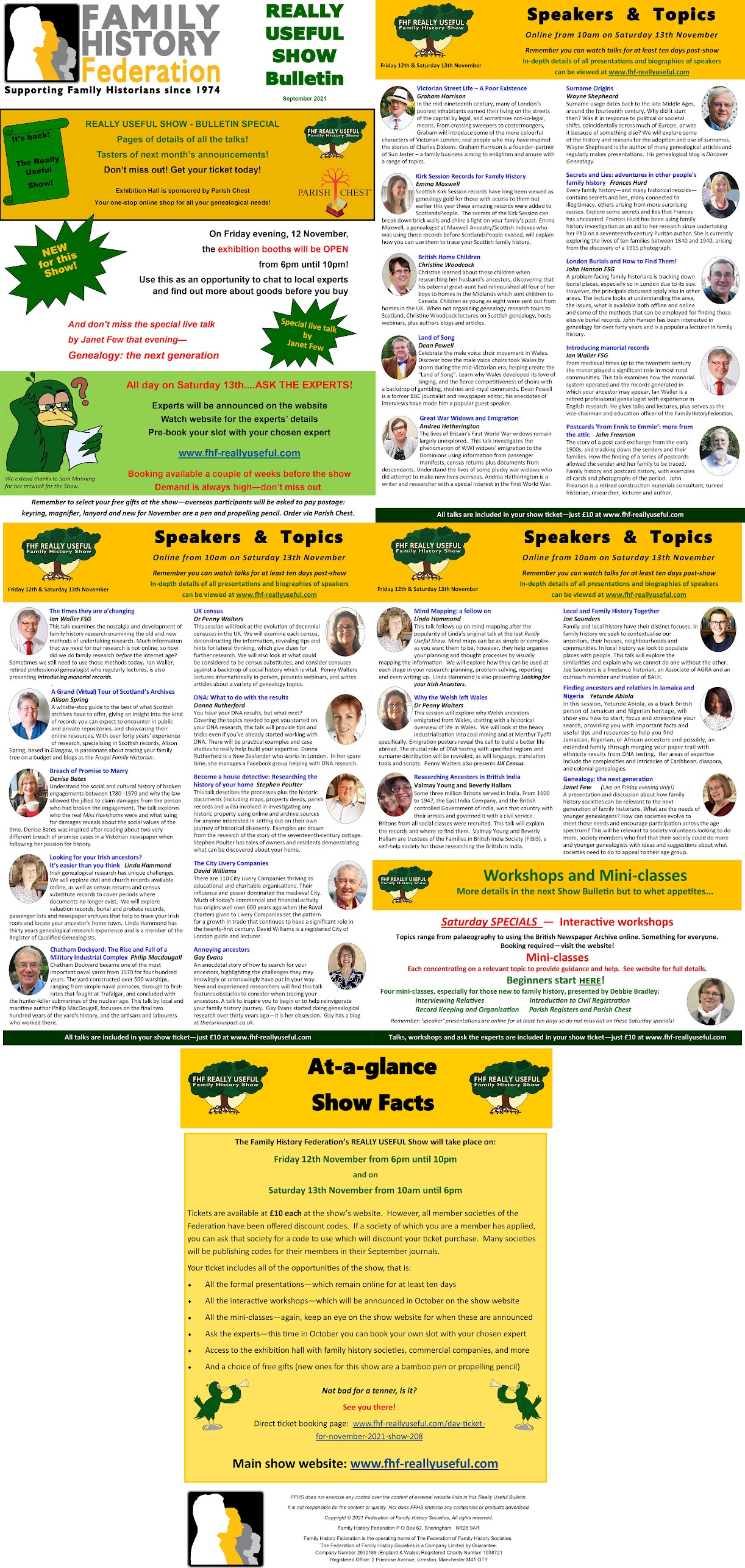
The FHF REALLY USEFUL Family History Show

 The fall edition of the FHF REALLY USEFUL Family History show is set for November 12-13. Tickets are now on sale for £10, a superb value.

I am pleased to say that I will be giving a talk at the show, titled Surname Origins: Why? When? Why then?

Surname usage dates back to the late Middle Ages, around the fourteenth century. Why did it start then? Was it in response to political or societal shift, coincidentally across much of Europe, or was it because of something else? We will explore some of the history and reasons for the adoption and use of surnames.

See the brochure below for more information and go to the website here for more information.


Monday, 30 August 2021

Travelling

I received one of those funny but inspirational stories from a friend this week. It was titled Memories and was about someone of my generation explaining to a young person, things about their childhood. I am sure readers will have seen many similar messages with tales told by older generations meant to relate their different their experiences were to people much younger.

I am not sure where this particular story originated. I did find it on a post on a website called Little Things published on 13 July 2015, although I am not sure it was first posted there. Little Things is explained as being “a helpful hub that makes it easy for moms and families to spark joy in each other’s lives by sharing the special stuff that connects us.” It’s kind of like the missives from Erma Bombeck for those who remember her. There are a very large number of contributors to the Little Things posts.

As it happens, when I got the email, I was starting to write a blog post about home entertainment, such as the first TV our family ever had. I am still composing that one, but the email got me sidetracked and I decided to post this one first.

Anyway, the story in the email was about fast food. A child asked his father, “What was your favorite fast food when you were growing up?” And the father responded, “We didn’t have fast food when I was growing up. All the food was slow.” And it went on from there. You can read the whole thing on the Little Things website.

One sentence struck me and made me think about the lives of my own parents as well as other ancestors: “Some parents never owned their own house, wore jeans, set foot on a golf course, travelled out of the country or had a credit card.” Now, that is not totally true of my parents, except for the travelling part.

I thought further about that and realized that neither of my parents had ever travelled outside of North America. They both had family members who lived in various parts of Canada and the US and did visit with them occasionally. Apart from my father’s service in the Royal Canadian Air Force in WWII, during which time he was posted to many different bases in Canada, the furthest they ever travelled, at least for fun or vacation, was to California. Growing up, I did not think that was unusual.


We arrived where we are, of course, because some of our ancestors came to Canada from their original homes primarily in the British Isles. My in-laws were from Scotland and they emigrated in the 1920s. They went back a few times in the 1960s to visit their families. My paternal grandfather, the first Shepheard to come over, arrived in 1907. Other ancestors arrived in North America from England, Scotland and Germany in the early part of the 19th century. These, of course, were not pleasure trips but voyages of necessity taken to find better lives.

To get back to foreign travel, I might have been the first person in my immediate family to travel outside of North America. I was one of the Boy Scouts in Calgary to be selected to go to the World Jamboree in Greece in 1963. I was 17 at the time. My wife also travelled as a young person (aged 12) when she accompanied her mother to England, Scotland, Ireland, Germany and Italy to visit families in 1961.

Over the years, we have flown to many different locations in Canada and the US for business and pleasure. Foreign vacations, while infrequent, have not been something strange for us. Our children have all flown to many places now, although our oldest has also not yet been away from North America.

In Canada and the US, we have taken flights to or from British Columbia, New Brunswick, Nova Scotia, Ontario, Quebec, Arizona, California, Florida, Louisiana, Nevada, New Jersey, New York, Oklahoma, Pennsylvania, Texas and Virginia.

Internationally we have been on trips to Australia, Belgium, China, Cuba, England, France, Greece, Indonesia, the Netherlands, the Philippines, Scotland, South Korea, and Taiwan – although some of them were only for a day or so as part of a more extensive tour.

All that makes it sound like we are real jetsetters but that would be a stretch. We have been very lucky to be able to visit family and friends in many of these places.

Our children and grandchildren are much more attuned to travel that we were and certainly what our parents were. The world has grown smaller through each generation. A few hundred years ago, travelling across a parish or county was counted as a major trip. As time progressed and necessity prevailed, people moved around mainly for work, mostly locally, until leaving a country became necessary to prosper or even survive.

What travel we have been involved with is a lot different than that of our ancestors. They were intent on finding new lives and opportunities. Many of them were likely part of a general migration.

The purpose of one of our trips was to see the areas where our ancestors had lived. What we could not learn was what the conditions were that had made them decide to venture across the world.

I have written and talked a lot about whether such moves were the result of Mother Nature’s intrusion into lives and livelihoods. Did the physical environment change to the extent that making a living or obtaining enough food were made too difficult? One of my talks, available to listen to is on the Legacy Family Tree Webinars website.


We still have a list of places we would like to visit, some of them again. Most are for our own interest although it is always great to see and learn about places where past family members have originated. Hopefully we will be able to get on the road or in the air once this current “plague” is done.