In the preparation of an article I am writing, I have been looking at the history of a particular family. One of the individuals was a woman by the name of Doris Fisher. She was the first-born of a couple by the names of James Fisher and Minnie Elizabeth Buckland.
Before I get to Doris, I would note that James was actually James John, but on almost every document I have found he did not use his second name. Being a relatively common name, it led to some complicated searching to figure who he was and to what family he belonged. His birth registration filed in 1854 shows his full name. So does his baptism record, however, he was not baptized until 1872 which added to the complexity of the search.

On every
census, voters list, birth and baptism records of his children, and even on his
marriage record James John was shown as just James. On his 1927 death
certificate his full name was finally recorded again. One of the things that
allowed me to identify him was his occupation. For most of his life he was a
builder / decorator. From that and the names of his children I could track him
around southeast England as he obviously moved to find work in developing
communities.
Doris was born in 1890. Her birth record shows just “Doris” but her baptism record has Doris Isabel. The second name was important in finding her on subsequent documents. She was living at home with her parents in 1891 when the census for that year was taken but disappears from family records afterward. I thought for a long time she might have died or emigrated, but I could find no death or passenger record to confirm either scenario.

A 1928 passenger list recorded her mother, Minnie E. Fisher, on her way to Canada, to join with a son, Mr. H. Fisher (Harland), who lived in Vernon, British Columbia. There was also a note that her nearest relative left behind was a daughter, Mrs. D. Wood, of 375 Harold Road, Hastings, Sussex. The address was the family home for many years and the person I thought could only be Doris. Now the challenge was to find when she married and what his name was.

The search led me in circles, though. Voters lists for Hastings for 1929 showed both Minnie Elizabeth Fisher and Doris Wood living together at 375 Harold Road. This list post-dated when Minnie left the country which is not unusual as it can take a while for civil record administration to catch up. By 1930, Doris, now shown as Doris Isabel Wood, had moved to another location in Hastings. Interestingly, Doris’s husband was not shown on any voters list with her indicating they had separated or even divorced.

I wondered if she had died in Hastings and when. The death record might give me some information on her family connections. A search on FreeBMD found only one person who fit her age and location: Doris Wood, age 60, died in 1951, in Hastings. I took a chance and ordered the record from the General Record Office. On the certificate her usual residence was 69, Southwater Road which was the same as on the voters list; her husband was George Wood, kennelman; and the informant was her son, L. P. A. Wood, living at the same address as Doris.

Now I had another name to look up. So, I did. Leonard George Albert (not L.P.A. as Doris’s death record had stated) was born in 1920 in Wood Green, Middlesex to parents George Edward Wood and Doris Isabel née Fisher.
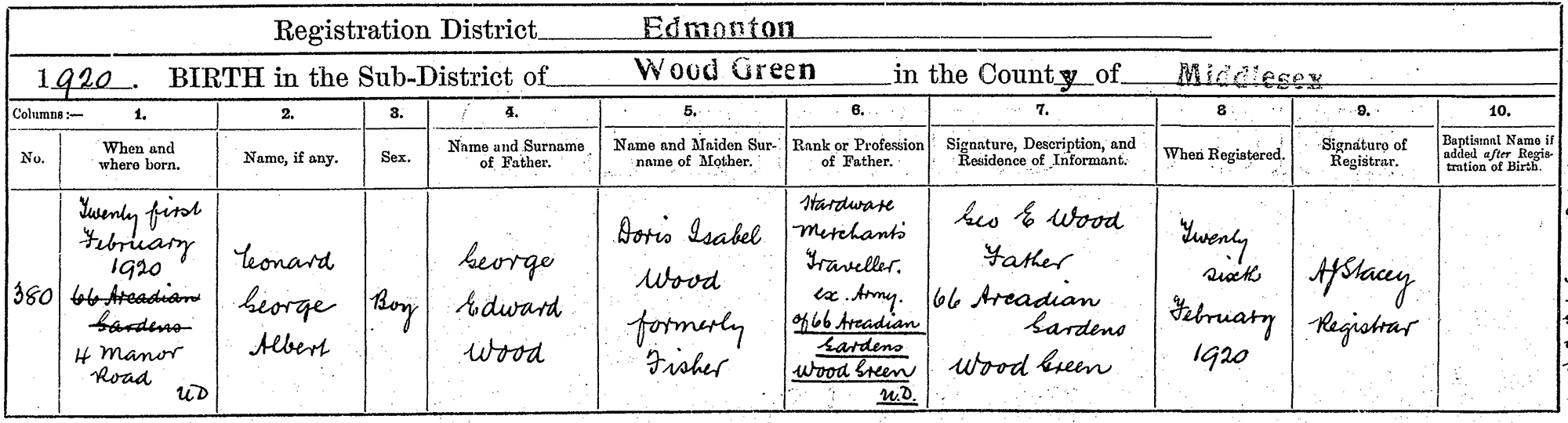
In later years, Doris was found on voters’ lists and the 1939 register living with her son, Leonard, in Hastings. Leonard served in the military during World War II but returned to Hastings after it was over to again live with his mother until her death in 1951. It appears he never married.


The family was also found on the 1911 census, living at 30 Guildford Road, Brighton, Sussex. They had been married less than a year then. With them were Charles Wood (b. 1868-69) and Emily Frowd Wood (b. 1866-67). All of them were indicated to be Visitors. But were they related?

I had found
most of the information related to the Fisher family. The rest of the Wood
family was to be a bit more complicated.
The 1921 census stated that Doris, George and Leonard lived in a residence belonging to H. C. Pearcy. In 1911 Henry Charles Pearcy (b. 1873-74) and his wife Martha Alice (b. 1875-76) lived with Annie Wood (b. 1841-42), who was the “wife’s mother.” Their address of 48 Pellatt Grove, Wood Green, Middlesex was also the address shown on the 1909 marriage for Charles Valentine Vickers Wood (b. 1868-69) and Emily Frowd Keevil (b. 1862-63).
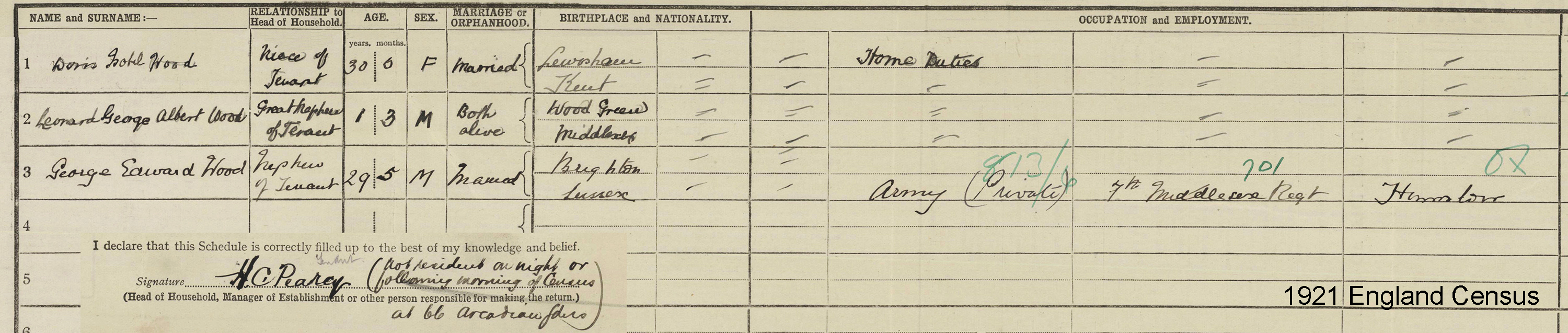
One of the witnesses to the nuptials was Alice Pearcy, very likely Charles’s sister. That seemed to establish connections between George Edward Wood, Charles Wood and the Pearcys. Was George a son, a nephew, or what?

The family
of Charles Valentine Vickers Wood (b. 1836-37, d. 1879), from results of
searches of censuses and other records, included parents Valentine Vickers and
Annie (Woodall) Wood (b. 1841-42) and their children, Annie Jane (b. 1862-63),
Martha Alice (b. 1863-64) and Charles (b. 1865-66). Charles’s 1950 death record
has his age at 86, suggesting a birth year of 1863-64. We had our Wood family
then. Given their unusual names it is hard to argue that Charles and Emily are
not the same people on the several documents even though their recorded ages
differ.
Census records have a variety of ages for the Wood children. On the 1881 census, Annie Jane’s birth year was shown to be 1863-64, Martha Alice’s was 1864-65 and Charles’s was 1865-66. On the 1901 census, there is a family headed by widow Annie Wood (b. 1843), living in Great Yarmouth, Norfolk, with children Charles (b. 1868-69), Annie J. (b. 1866-67) and Alice (b. 1870-71). Their birthplaces match most other records even though their ages do not. Some liberties appear to have been taken relative to the birth dates. Also on this census record is a George Young (b. 1892-93) an “adopted son.”
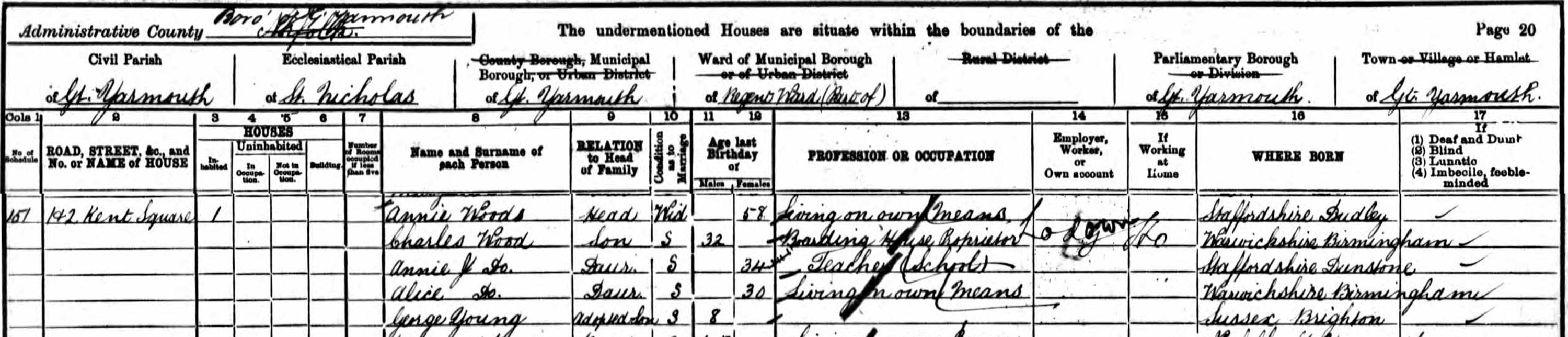
Now I came to a dilemma. Or was it a fabrication? The only marriage record I could find was dated 30 November 1910 between George Edward Wood and Doris Isabel Young. His father was shown as Charles Wood and hers as George Young. The relationship with Charles could have right, but the name of Young appeared to be totally wrong, given other information from the 1911 and 1921 censuses and the 1920 birth record of Leonard Wood.
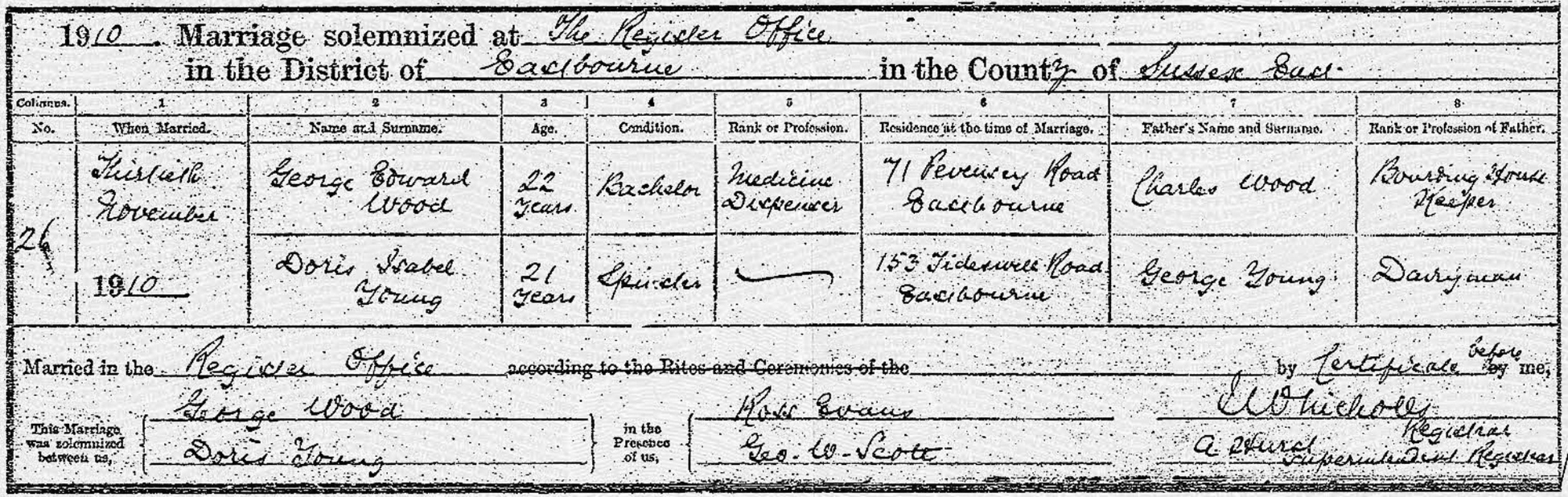
Was George
Edward Wood actually George Young, the adopted son of Annie Wood? The age
matched and the name shown on the marriage record was curious.
George was
very likely not the 22 years of age (b. 1887-88) shown on the marriage
certificate as most other documents show his birth around 1892. With George
being underage, it might have led the couple to take liberties with the truth
and marry in the register office rather than in a local church. He was recorded
as being 20 on the 1911 census (b. 1890-91) and 29 on the 1921 census (b.
1891-92). So, there was a pattern of growing younger as he aged.
Was there a
clerical error made when the marriage record was filled out or did George and
Doris conspire to give wrong information. The fact that Doris signed as Doris
Young suggests the latter.
I am not
sure we will ever know the true facts.


