Tuesday, 18 December 2018

Webinars: Are they the future?


I have noticed that more family history societies and other genealogical organizations are offering webinars as a way of disseminating information and, I presume, attracting new members. Such talks are usually free to view on the day they are given. The presentations are recorded and stored for future viewing, some free, some for a small fee and some only for the members of the societies who sponsored the talks. Over time, many groups have assembled libraries of webinars.

Conferences, both large and small, are also regularly recording presentations for later viewing. In some cases, they are live-streamed.

This past September I presented one of my favourite talks, Genealogy and the Little Ice Age, at a one-day conference in Seattle, Washington, put on by Unlock the Past. It was scheduled in advance of their Unlock the Past Cruise to Alaska. All of the talks were recorded by Legacy Family Tree Webinars. They are now up on the Legacy website, including mine. That was a first for me and I am delighted that the talk has been viewed by a several people since it was made available. A family history group in Washington even approached me to ask permission to show the webinar at their meeting in January. Of course, I said yes!

I have offered other talks to Legacy for their series. Next year is already full, so mine, if they are accepted will not likely be available until 2020. I have signed up with the Virtual Genealogical Association to present a talk about Using Parish & Other Records to determine how natural phenomena affected people & communities. It is scheduled for 20 July 2019.

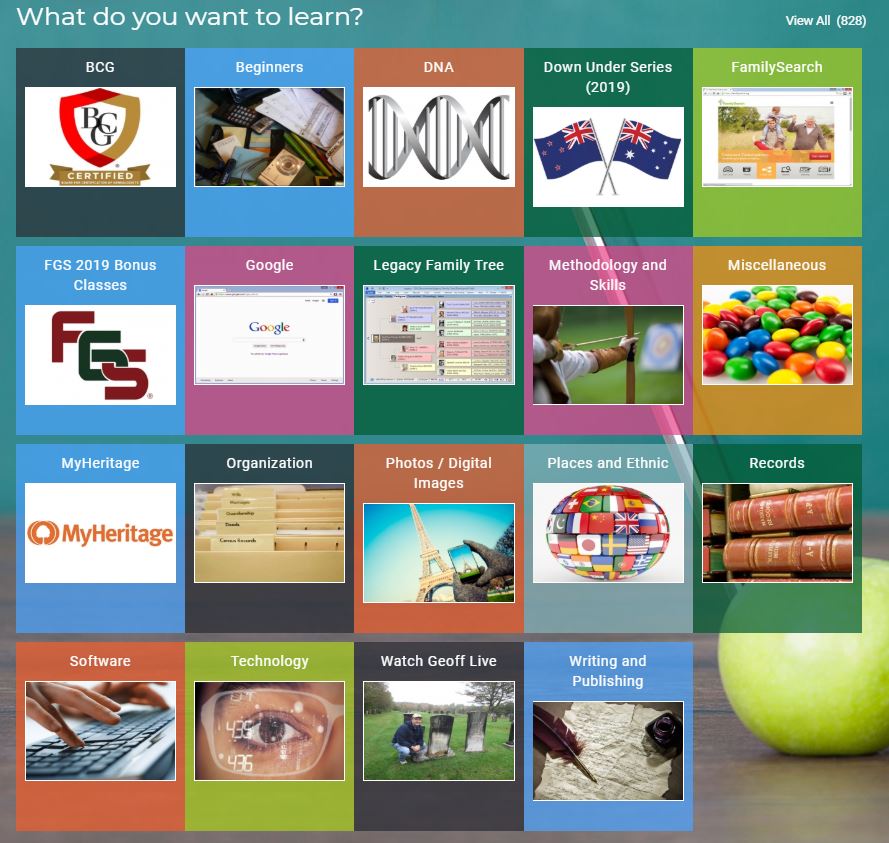
Legacy Family Tree Webinars now has 828 presentations in their library. https://familytreewebinars.com/ You can take out a membership – it is really inexpensive – and watch what you want, any time you want. One of their most exciting developments, described in a recent press release, is in offering closed captioning for recordings released since 1 May 2018, as well as its most popular 50 webinars. Legacy is spreading its wings around the world with featured subjects and regions, such as the 2019 lineup for their “Down Under Series” especially for genealogist in Australia and New Zealand. https://familytreewebinars.com/downunder

In various blog posts, as well as society newsletters, I have become aware of many more webinars now available for the general genealogical community. Many groups have now scheduled presentations for the entire coming year.

Following is just a small list of other webinar sources that have recently come to my attention. This does not include podcasts or online courses – perhaps subjects for a future post here.

Virtual Genealogical Association: 2019 program has 40 presentations scheduled for paid members only. https://virtualgenealogy.org/programs/ They are also organizing a virtual conference for 1-3 November 2019 that has some notable experts in various subjects.

Southern California Genealogical Society and Family Research Library: 2019 Jamboree Webinar Extension Series will have 22 presentations. https://scgsgenealogy.blogspot.com/2018/12/ca-scgs-announcing-2019-jamboree.html

MyHeritage LIVE 2018: talks given at a conference held this past November are now available for viewing by the public. https://live2018.myheritage.com/

Ontario Genealogical Society: live, monthly presentations are available for free to the general public. Recordings of past talks can be viewed only by society members. Their 2019 schedule should be out soon. https://ogs.on.ca/webinars/

Rootstech: sessions from their last four conferences are available. You can find information about future meetings on their general webpages. https://www.rootstech.org/video-archive The live stream schedule for the 2019 event has already been set. https://www.rootstech.org/salt-lake/live-stream-schedule?fbclid=IwAR0RD1mlEQgUcAajBSk3Lnu11bXtIGYHbzE4f679t49mFD1bgJiYYGtPRPY

FamilySearch: has an extensive library of webinars and classes available for viewing for free https://www.familysearch.org/wiki/en/Family_History_Library_Classes_and_Webinars#Past_Webinars_.26_Handouts

New England Historic Genealogical Society: American Ancestors: offers a free webinar guest account to watch a selection of 23 webinars they have online or you can join the society for even more. https://www.americanancestors.org/guest-user-resources

YouTube: a search of the Internet for “genealogy on youtube” brings up a staggering 27,000,000 hits. No-one will have time to even go through the list, but up front are many webinar-type presentations from many professional genealogists on a wide variety of topics. One probably needs to narrow down the search to specific subjects so as not to be overwhelmed. For example, searching for “dna genealogy on youtube” gets only 1,890,000 hits, although “england genealogy on youtube” gets 4,470,000. Still too many to look at, but you get the drift.

However you look at genealogy webinars, and wherever you look for presentations, there is a lot of stuff out there, much more than shown above. (Readers of this post may wish to add to the list of sources.) Most of the presentations are free to view and you don’t have to travel to a faraway place to listen and watch.

Progressive societies and organizations, including commercial enterprises, are increasingly offering webinars focused on genealogical research. Is this the way of the future for genealogical societies, education and publication?

The only problem I can see is that none of us have enough time to watch them all.

Tuesday, 11 December 2018

Local Genealogical Society Projects: AGS Medicine Hat Branch


Most family history societies have ongoing projects having to do with finding, compiling and publishing information about people in their region. Cemetery lists, with that all-important death information, are one of the most popular subjects many organizations work on. These days, the results of many of them are being put online where we can easily search them.

But there are many other subjects concerning the records of people in the past that societies find opportunities to get involved with. One I just found is an ongoing project being done by members of the Medicine Hat and District Genealogical Society, a branch the Alberta Genealogical Society. They are in the process of digitizing past Alberta Government Telephone books. These are the old printed books distributed before the era of the Internet and before the company was privatized and became Telus.

This is a description of the project on their website: https://mhdgs.ca/phonebooks.html

Alberta Government Telephones (AGT) was the telephone provider in most of Alberta from 1906 to 1991. It was formed by the Liberal government of Alexander Cameron Rutherford in 1906 following the acquisitions by the government of several independent telephone companies. In 1908, AGT acquired the Bell Telephone Company's Alberta operations for $675,000. It eventually served almost all telephone customers in Alberta outside of the Edmonton area, where telephone service was operated by the Edmonton municipal government.

       Alberta Government Telephones was directly managed by the province's Department of Public Works as a public utility until 1958, when it was transformed into the Alberta Government Telephones Commission, a crown corporation. From 1945 until 1960, AGT operated the province's educational radio station, CKUA.

      In 1969, AGT built what was then Edmonton's tallest skyscraper as its new headquarters, joined by a second tower in 1971; they are now called TELUShouse at ATB Place.

      In 1990, the Alberta government began the process of privatizing AGT, and formed Telus Communications as a holding company to facilitate the transfer. In 1991, the province of Alberta sold its remaining ownership interest in AGT to Telus for $870 million. Telus acquired Edmonton Telephones Corporation (Ed Tel) from the city of Edmonton in 1995; Ed Tel had been created only five years earlier. In 1996, the AGT and Ed Tel brands were retired in favour of the Telus name. Telus merged with BC Tel in 1999 to form the present-day Telus Corporation.

      Telus Yellow Pages were downsizing and 10 decades of old Alberta telephone books were given to the volunteer group Medicine Hat Telus Community Ambassators. The Ambassitors in turn donated the phone books and their shelving units to the Medicine Hat Genealogical Society to be scanned and stored as one unit. The project will be ongoing until complete.”

I recall when they started the work back in 2015, but had not followed up on the project to see what progress was being made. Clark Lang, the society member in charge of the project, informed me last month that they were now on phase 4 of the project. Phase 1 was the scanning of all Southern Alberta books to 1950. Phases 2 and 3 involved scanning through to 2001. They completed these much sooner than anticipated. Phase 4 is indexing the scanned images which is well along. They are currently receiving 400 to 500 hits on their website.
 
Clark Lang busy indexing images; Scanner at work on phone book
I was delighted to find the information online when I went looking for phone numbers of some family members. It was easy to access.

It is a great project and I am sure will be of interest to anyone looking for information about families in Alberta back to the early part of the 1900s.

Tuesday, 4 December 2018

Populations Past – Atlas of Victorian and Edwardian Population


The Populations Past – Atlas of Victorian and Edwardian Population website and data came to my attention in a blog post by John Reid (Canada’s Anglo-Celtic Connections) on 29 November 2018. Thanks John!

What struck me in particular was that the host of the site and source of some of the data used is CAMPOP, the University of Cambridge project, Cambridge Group for the History of Population and Social Structure. I have just completed an article about the History of Occupations, using information from several Cambridge Group studies. It will be published in Family Tree (UK) magazine next year. So, I was delighted and intrigued to find even more depth to their website.

As John indicated, and as described in the Population Past overview, the “website allows users to create and view maps of different demographic measures and related socio-economic indicators every 10 years between 1851 and 1911. These include fertility, childhood mortality, marriage, migration status, household compositions, age-structure, occupational status and population density.” These are powerful data that will greatly assist in unravelling family histories during the second half of the 19th century. The analyses also show other aspects of using such census data that many of us may not have thought about.


Of importance in this time period, “The second half of the nineteenth century . . . was a time of transformation from a relatively 'high pressure' demographic regime characterised by medium to high birth and death rates to a 'low pressure' regime of low birth and death rates, a transformation known as the 'demographic transition'.” We are fortunate, in terms of British family history, to have such detailed data from censuses and civil registration files for births, deaths and marriages. As genealogists, we are also lucky to have access to studies such as those done and published by the Cambridge Group researchers.

The work is still in progress but there are some interesting results and trends already available, especially the data from employment. One can review information about workers by socio-economic status, skilled versus unskilled occupations of men and employment of women and children.

I had a look at all the data from Plympton St. Mary Registration District in Devon. This is the area from which my Shepheard ancestors came, so it presented an opportunity to look at the censuses from a different perspective.

The region is defined as agricultural, based on its occupational structure and population density. Between 1851 and 1911, it did not change much in character, having its lowest density of 0.21 persons per acre in 1851 and its highest in 1911 at 0.30 persons per acre. There was never much in the way of manufacturing industry. Most of the occupations are related to farming, including tradesmen and labourers. Farm labourers and other unskilled workers, did drop from about 48% of all working-age men in 1851 to 40% in 1911. Skilled and semi-skilled workers rose from 29% of the male workforce to 35% in the same time period. Professionals and non-manual skilled workmen stayed about the same, between 20% and 23%. Those numbers are consistent with what I have uncovered through examinations of parish registers.


In terms of working women, the region was probably not unlike many others in England and Wales. Almost half of working-age women were employed as domestic servants throughout the record period; 60% of all single women worked for wages. In 1851, 38% of widows were employed, dropping to 28% by 1911 – not a large difference.

Child employment was high, not unexpectedly. More than 40% of boys and 21% of girls aged 14 to 18 were recorded as full-time workers on every census. In 1851, 17% of boys and 6% of girls between 10 and 13 were employed. That dropped to 3% and 1%, respectively by 1911.

Mortality was very high for infants and young children: well over 10% failed to reach their first birthday and another 7% did not attain the age of five years. Those numbers were fairly consistent from 1851 to 1911. Nationally, the death rates were around 15% for infants. Young children fared better, dropping from 15% to about 7% between 1851 and 1911.

There is a lot of other information to be discovered about family structure, fertility and households, all broken down by registration district across England and Wales and accessible using an indexed map. It is not impossible to spend hours reviewing data from parishes in which ancestors lived.

Anyone with British ancestors is well-advised to have a look at the website.