Tuesday, 3 May 2016

Historical Trends in Parish BMD Register Entries 2

In my last post on this subject (19 April 2016) I showed in graph form the statistics of baptism, marriages and burials for the parishes of Plympton St. Mary and Plympton St. Maurice in southwest Devon, England. For the combined plots we noted the general decline in baptisms during the 17th and 18th centuries and rapid increase during the first half of the 19th century.
 
Figure 4 – annual baptisms, marriages and burials as recorded in the Church of England registers of Plympton St. Mary and Plympton St. Maurice Parishes – 1603 to 1957
Various sharp spikes in burials can mostly be attributed to epidemics or wars (Figure 4 – from blog post of 19 April 2016). Drops in baptism numbers might be a result of the same events. A major spike in burials occurred around 1644. This was during the time of the English Civil War. Battles raged in various localities of southwest Devon and it appears many of those who died in the conflict were buried in the Plympton area. In 1688, the Glorious Revolution began with William of Orange eventually taking the Crown from King James II. Again Devon was the site of battles resulting in deaths and burials in the area. The Plympton St. Mary burial register does record that soldiers were buried during this time period.

The register does not specifically indicate the causes of death between 1625 and 1627 although there were a large number of children who died. This may represent a period of famine as it extends over several years. It might also represent plague that had broken out in a few spots around southern England at the time. The Cholera epidemic of 1832 is clearly evident.

There is a very prominent spike in marriages on the Plympton St. Maurice graph, between 1653 and 1658. This was, of course, during the Interregnum, after Oliver Cromwell’s Puritan government had seized power. I commented on that in a blog post on 14 January 2014. All marriages during this time were to be performed by Justices of the Peace in central market towns one of which was Plympton.

The divergence of the baptism and burial trends beginning around 1802 (baptisms outstripped burials) is surely an indication that better times had come to the area and population was increasing – outside of a few setbacks from time-to-time over the next several decades.

Interestingly the Spanish Flu of 1918 does not seem to have been a factor in this part of Devon as there is no discernible spike in burials. There were, however, many deaths reported during the Great Depression of 1929 to 1934 as well as a significant drop in baptisms. These events fit with criteria for famine as being a major cause of a deterioration of living conditions. Effects of the Second World War are shown in the increase of marriages and burials beginning in 1939 and in baptisms from 1945 onward.

All the significant spikes and troughs are worth investigating to see if there were changes to political or environmental conditions that affected the rapid increases or decreases in populations.

The mid-1600s to the early-1700s period correspond to the height of the “Little Ice Age.” This is a time in Earth’s history when the Northern Hemisphere was significantly cooler that during the Medieval Period or modern day (Figure 6). The Little Ice Age began around 1300 and continued into the 19th Century with its most devastating period in the 17th Century (Figure 6).
 
Figure 6 – graph depicting winter severity in Europe between 1000 and 1900. Note two cold periods in the 15th and 17th Centuries.
Agricultural productivity would have been adversely impacted during the cold period which would have had the effect of reducing the ability of people to support and feed themselves. Population would likely have declined as well, a direct result of the drop in production of foodstuff and quite possibly the migration of families to other parts of Britain. Many people moved to the large cities or other parts of the World where better living conditions were believed to be possible. Indeed, the 17th Century was a time when global exploration was at a zenith and new British colonies were developed in North America and elsewhere.

Concurrent with the environmental changes, there were new developments in technology and new methods and mechanisms employed in agriculture – part of the early Industrial Revolution. The improvements in farming techniques meant even fewer individuals were required to work farms. Growth of manufacturing and processing industries in many parts of Britain drew thousands of people from rural areas to cities. These developments did not take effect until the late 18th century, so do not explain the drop in numbers during the early part of the 1700s.

Parish registers can provide much more than just names and dates. An analysis of entries over long periods of time can show the influences of many events on the lives of residents, especially those of strife such as war, disease, environmental change and political upheaval that may have caused people distress and resulted in migration.

Most peaks, troughs and trends observed on plots of BMD data are related to specific historical events. A study of those events, form both a local as well as regional viewpoint will be very helpful in unravelling how the lives of individuals were affected, why families flourished or were devastated or what caused people to move.


Wayne Shepheard is a volunteer with the Online Parish Clerk program in England, handling four parishes in Devon, England. He has published a number of articles about various aspects of genealogy and is the Editor of Relatively Speaking, the quarterly journal of the Alberta Genealogical Society. Wayne also provides genealogical consulting services through his business, Family History Facilitated.

Tuesday, 26 April 2016

Time Travel to Visit Nicholas Shepheard (1716-1786)!

(Today’s post is in response to an invitation to a Genealogy Blog Party initiated by Elizabeth O’Neal on her blog, Little Bytes of Life. She suggested bloggers write about visiting an ancestor accompanied by Time Lord Dr. Who in his time machine, TARDIS. The visit would be to one individual who was notable in the family, at least to the blogger. Links to all posts will be published on her blog at the end of April. I found the idea of a visit intriguing and decided I wanted to meet a person of some importance in my family in 18th century Devon, England. So I interrupt my normal blog posts with this brief flash from the past as I visit Nicholas Shepheard, born in 1716 in Cornwood Parish, Devon, England, who was my 5th great-grandfather.)

I wrote about Nicholas on 1 July 2014 when describing the Bells of St. Michael’s. As the Churchwarden at the time, he was instrumental in having the bells manufactured and installed in the parish church in 1770. I think that was likely a memorable event for the whole community, most especially for the Shepheard family as Nicholas’ name was cast into the bells. That really impressed me when I saw them first-hand in 2004. You can hear the bells being rung (with a little wind noise unfortunately) on my Cornwood Online Parish Clerk webpage. I am confident that each time the bells were rung before Nicholas died in 1786, he must have smiled. I also described his home in Cornwood, East Rooke, in a blog post of 25 February 2014.
 
Part of one of the bells showing the name of Nicholas Shepheard Churchwarden
Anyway, here we go on our journey to Ye Olde Devon…

With Dr. Who on the TARDIS, we touch down in the field next door to the East Rooke home where Nicholas, his wife, Mary (nee Barrett) and his family live. The time is late morning of an early summer Sunday in 1780. The sun is already high in the sky and the weather is warm and inviting. The view from the house, overlooking the Yealm River valley is spectacular!
 
View from East Rooke looking toward the Yealm River valley and the village of Cornwood, Devon (on the left)
Nicholas comes out to great us. He does not seem surprised that we have arrived for a visit, at least not any more than I am to be there. He marvels at the unique structure that is firmly settled in his front yard. The little box seems an unlikely thing for two men to suddenly emerge from.

The house is an imposing building, two floors with large windows facing south to catch the natural light.  Behind the house are smaller buildings, constructed of stone that house some of the livestock and where goods and implements are stored. All the buildings go back some decades with many local workers having been employed to finish them, including other members of the Shepheard family who were experienced tradesmen.
 
Main house at East Rooke farm as it looks today
Nicholas is a dapper-looking man, already dressed in a wool suit with vest and leggings, befitting the Squire that he is. He looked much like pictures I had seen before in articles about late 18th century fashions. I can’t help but think there is a resemblance to Shepheards of later years. His handshake is firm and his look confident which give us the impression this is a man of strong character and determination. His welcome is cordial and friendly indicating he is kindly and a gentleman in every sense of the word.
 
A late 18th century gentlemen dressed in a wool suit meant for casual wear
As we stroll across the farmyard we happen to meet my 4th great-grandmother, 10-year old Jane Treby Shepheard. She is just bringing a basket of eggs to her mother, from the chicken coup in one of the out-buildings. She smiles and curtsies to us, in the manner of well-brought up children of the day. It is a bit strange knowing that, in just 11 years she will marry her first cousin, John Shepheard.

Although they have servants to help with the home and the fieldwork, Nicholas and Mary have insisted their children be responsible and participate in the running of the farmstead, including doing much of the work. They all later went on to become hard-working and responsible members of the community. The couple had eight children between 1761 and 1775. One daughter, Mary, had died as an infant however the others appear to be thriving. We saw several of them going about their chores while we walked and talked with Nicholas. All greeted us kindly and with respect. My great-grandfather showed obvious pride in them.

While alive, Nicholas never became a grandfather, so was denied that enormous personal pleasure. He did not know that would be case when we visited him, of course, which made me a bit sad. Four of his children would eventually marry, the first not until seven years after his death, though. Only two would have children of their own but they both have a long line of descendants, including me. (I realized in typing this that I have not traced all of them down to present day, so there is another project for me to tackle.)

I have not found a will for Nicholas. He is certainly a man who one would expect to have prepared such a document. Perhaps he died suddenly, before he had time to compose one. Or maybe it is still buried in the archives waiting to be discovered and indexed. In any event, all his property went automatically to his wife and sons.

We take a short tour of the farm to see how the crops were faring. Nicholas comments the prices for corn (wheat and other grains) have climbed over the years since he took over the farm in 1756, on the death of his father. The future looked bright in that respect. The winter had been quite cold, as it was across southern England but the spring and summer were warm, if a bit dry.

The fields are divided by stone walls and hedges, the partitioning having taken place likely centuries before, when the manor estates were created. The Rooke lands had been owned by the Shepheard family since the early 1600s although Nicholas could not say exactly when they had been acquired. Altogether the farm totalled just 62 acres, in two segments called Middle Rooke and East Rooke. Nicholas also owned another farm further south in the parish called Knotts or Woodburn which was 45 acres in size. Alongside the East Rooke lands, to the east lay a 20 acres group of parcels set aside as charity lands by Nicholas’ father and several other gentlemen of the parish in 1700, called Wakeham’s Rooke. It was managed by Nicholas and his brother, Richard (who was also my 5th great-grandfather and the father of John who I mentioned earlier – but that is another story).
 
Satellite view of the lands around Rooke farm; the main house is located on the southwest corner of the T-intersection on the lower-right side of the photo
Nicholas is actively involved in the community, not just as Churchwarden, but as a tax assessor and collector, and a trustee of the local charity that owns Wakeham’s Rooke. He has other business interests in the area as well. He met and married his wife, who is 20 years younger than he, in Ermington Parish where she lived. He was then 44, quite successful but still single. He was surely ready then to have a family to succeed him. I got the impression that, as a somewhat older man, he smitten by this sweet young thing he met one of his business trips to the area.

My 4th great-grandmother’s second name is Treby which may have been given to her as a sign of the respect Nicholas had for an important family in the area, possibly a business associate. Nicholas did not confirm this, but it is interesting to speculate about it anyway. We do not get a chance to meet any of his neighbours.

Let’s not forget about Mary. She is also a strong and capable person something that is in evidence when we meet her. She brought property in Ermington parish into the family, lands one of their sons eventually was to own and operate. She continued to manage the Cornwood parish lands after Nicholas’ death, with the assistance of her sons and daughters, until her death, of influenza, in 1803 at the age of 67. She did not leave a will, but there were specific instructions from her as to the disposition of property and payments to be made to her daughters indicating she cared a great deal for her children and their futures.
 
East Rooke far, on the left, looking from the steeple of St. Michael and All Angels Church in Cornwood; buildings on Wakeham’s Rooke are on the right; the hills of Dartmoor are in the distance
In the distance we hear those church bells at St. Michael’s ring out. Nicholas stops to listen and smiles. He says the family must get dressed and ready for services and begs his leave of us. We walk back to the TARDIS and say goodbye. It has been a memorable experience to meet him and see the farm up close. I hope to do it again as there is so much more to see, not just on the homestead but across the parish where my family lived for so many generations.


Wayne Shepheard is a volunteer with the Online Parish Clerk program in England, handling four parishes in Devon, England. He has published a number of articles about various aspects of genealogy and is the Editor of Relatively Speaking, the quarterly journal of the Alberta Genealogical Society. Wayne also provides genealogical consulting services through his business, Family History Facilitated.


Tuesday, 19 April 2016

Historical Trends in Parish BMD Register Entries

In a blog post of 14 January 2014 I commented on how certain events can be observed in an analysis of birth, marriage or burial records, particularly from entries in parish registers. That post dealt with a short term peak in marriages that occurred during the Interregnum (1649-1660) when marriages were decreed to be performed by Justices of the Peace in certain centres.

There are also long-terms trends evident in the parish records if one has such data summarized adequately. As an example, following are some observations of data from Plympton St. Mary and Plympton St. Maurice parishes in southwest Devon (Figure 1).

Entries in the registers of Plympton St. Mary parish are continuous from 1603 to 1982, so we have a great long-term view of births, marriage and deaths in the area. When combined with the 1616-1957 data from Plympton St. Maurice Parish we can see the statistical trends that cover the rural and urban areas around Plympton town. One should note that the numbers are only from Church of England records.
 
Figure 1 – index map to parishes in Southwest Devon
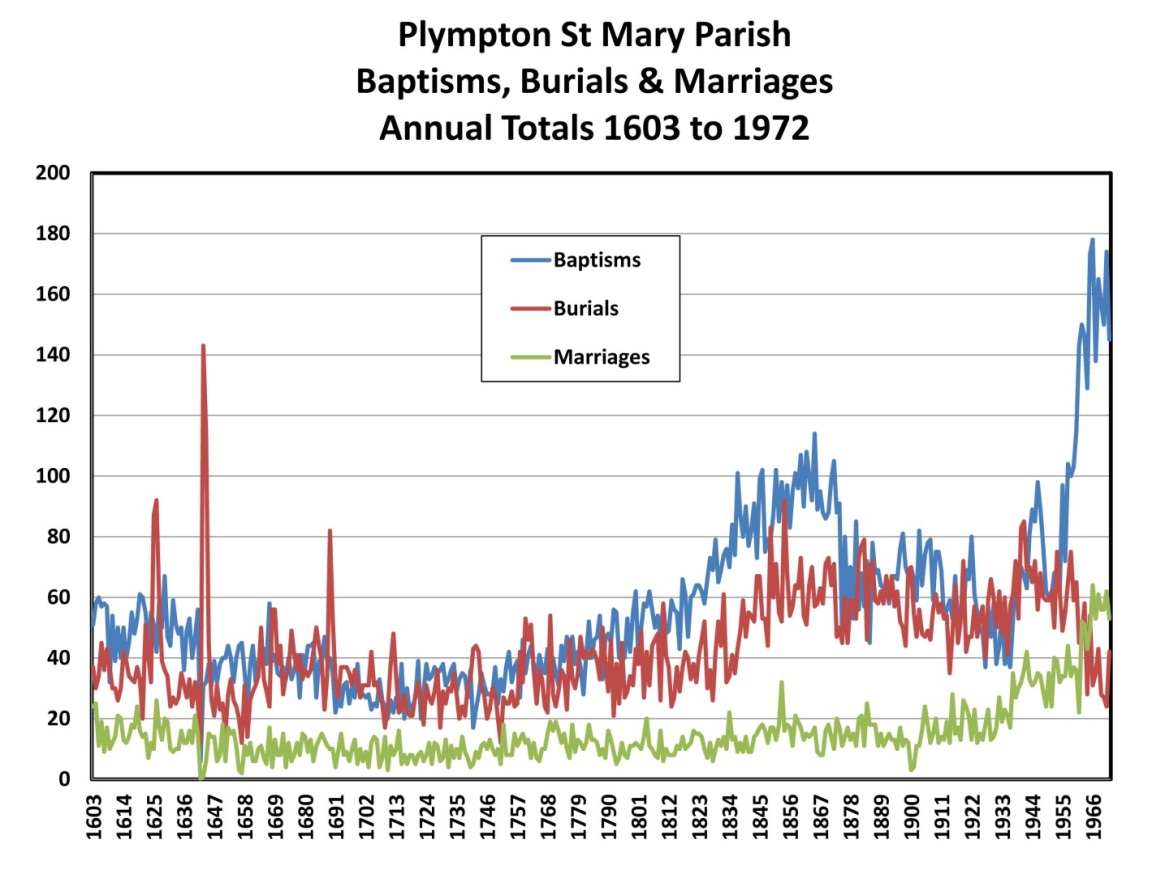
The more complete data for Plympton St. Mary parish (Figure 2) shows an early peak in baptism numbers around 1620 after which the number of baptisms dropped, with minor fluctuations, until about 1702 when the decline was arrested. From about 1668, and for many years through to the early 1720s, burials outnumbered baptisms, by almost 2,000 for the period, indicating a decline in overall population. Marriages declined in annual number slightly between 1603 and 1720. Numbers of baptisms rose after 1740 to a peak in 1862. They fell off again until the 1930s when rates climbed again. Following the Second World War there was an explosion in numbers, the beginning of the Baby Boom. Baptisms mostly exceeded burials in Plympton St. Mary parish throughout 19th Century, indicating population growth. With few exceptions, marriages were fairly constant throughout the 1600s, 1700s and 1800s and did not begin to rise significantly until the 1920s.
 
Figure 2 – annual baptisms, marriages and burials as recorded in the Church of England registers of Plympton St. Mary Parish – 1603 to 1972
The trends are slightly less pronounced for Plympton St. Maurice (Figure 3), mainly because it is a much smaller parish. It is almost wholly urban in character and probably experienced much inflow and outflow of individuals and families. Through the 17th and 18th centuries, baptism and burial numbers were almost in lock-step indicating a stable town population with little or no growth. The steady drop in numbers of baptisms, however, shows that overall population was probably in decline. The last peak in baptisms happened in the latter part of the 19th century. A decline in the number of baptisms continued into the early 20th century. Burials also increased in the early 1800s, peaking earlier than for baptisms, but then dropped as the 19th Century closed. Burials once again steadily rose during the 1900s. Interestingly, marriage numbers increased from the late 1880s even while baptisms declined.
 
Figure 3 – annual baptisms, marriages and burials as recorded in the Church of England registers of Plympton St. Maurice Parish – 1616 to 1957
The trends for both Plympton St. Mary and Plympton St. Maurice parishes, when combining rural and urban areas around Plympton Town (Figure 4), are somewhat clearer. Baptisms peaked sharply in 1865 and burials in 1883. In the previous two centuries, baptisms had steadily declined from a peak in 1629. The trend was not reversed until the 1740s. Burial numbers lagged baptisms until the 1640s. Thereafter they generally matched each other in number, until the late 1700s. Marriages were fairly steady throughout the 18th century, grew steadily during the 1800s and then rapidly increased beginning in the early 1900s.
 
Figure 4 – annual baptisms, marriages and burials as recorded in the Church of England registers of Plympton St. Mary and Plympton St. Maurice Parishes – 1603 to 1957
In contrast to the observed major decline in baptisms in these two parish during the latter part of the 19th Century, the population of the region actually increased (Figure 5); so what was the reason the Church of England events dropped in number? One explanation may be that, after the introduction of mandated civil registration in 1837, the importance of the Church as the repository of vital statistics data waned. Perhaps society developed along more secular lines, reducing the influence and meaning of religious services and, in particular, the Church of England. It may also be that non-conformist institutions assumed a more important role in baptisms, marriages and burials as regulations and laws affecting them were relaxed and larger numbers of people moved toward these churches.

Or, perhaps, other influences were in play, some of which we might surmise and some we have yet to determine.
 
Figure 5 – population of combined Plympton St. Mary and Plympton St. Maurice Parishes, 1801 to 2001 (Data is from Online Historical Population Reports and the UK Office of National Statistics. No census was taken in 1941.)
When the annual numbers for baptisms, marriages and burials are plotted over long periods of time, as seen here, many trends are apparent, with numbers increasing or decreasing in regular patterns. Individual anomalies also stand out, in the form of sharp spikes or troughs. Both are an indication of change in population and a reflection of specific events that unfolded in the communities. Recognizing these trends may give us better ideas about how changes were playing out in local communities which, of course, affected any ancestors who may have lived there at the time.

In my next post I will offer some comments on the contrast between church and civil records and what conclusions might be derived from the statistical analyses.


Wayne Shepheard is a volunteer with the Online Parish Clerk program in England, handling four parishes in Devon, England. He has published a number of articles about various aspects of genealogy and is the Editor of Relatively Speaking, the quarterly journal of the Alberta Genealogical Society. Wayne also provides genealogical consulting services through his business, Family History Facilitated.