Tuesday, 15 December 2015

What do your children want to know about your family history?

Many genealogists I know are starting to think about how they can interest and involve younger members of their family in their activities. Most societies are wondering where their future members will come from to continue their programs. Is that because we are all getting older and are worried about what will happen to all those years of work and the tons of information we have collected?

Whatever the reason, it’s not a bad idea to engage young family members in the pursuit of knowledge about their ancestors. They might learn something about themselves as well as about their history.

As the Editor of Relatively Speaking, the quarterly journal of the Alberta Genealogical Society, I just helped publish a whole issue dedicated to Youth and Genealogy. We had a variety of papers about how to get children started, what benefits there are to introducing them to genealogy and an outline of a new program initiated by our Society. There were even stories written by children themselves about their own backgrounds. The contributions were both interesting and informative. A list of the feature articles is at the bottom of this post.

In the process of sourcing and assembling material I learned quite a bit about what is out there for parents, teachers and others who want to show children what they do and how they do it, with respect to family history. Three genealogical societies in Canada now have programs on their websites that are helpful:

·         Alberta Genealogical Societyhttp://www.abgenealogy.ca/genealogy-for-youth The AGS Genealogical Project for Children and Youth. The first resource within this project (intended for children aged 6 to 9 years of age) has just been released on-line. Enjoy exploring!
·         Ontario Genealogical Socitey https://www.ogs.on.ca/lessonplans.php The OGS Family History Lesson Plans Project for elementary and secondary students began this past summer with the intention of connecting OGS with students by providing educational resources to educators.
·         Victoria Genealogical Societyhttp://www.victoriags.org/school/ The VGS Genealogy in the Classroom webpages provide lesson plans with resources such as printable genealogy forms and free online genealogy games.

I would be interested in hearing about other groups around the world that have similar genealogical programs for children and youth.

Anyway, back to the question I posed as the title of this post – perhaps the best way to get children started in looking at family history is to ask them what they would like to know.

How many people have you come across who have told you they wished they had asked their parents and grandparents about their experiences and personal histories? Have you muttered that to yourself as well on occasion? Now most of us spend countless hours and funds trying to find many of the answers that people we knew and grew up with might have been able to provide.

Don’t let your descendants make the same mistakes. Go ask your children and grandchildren what they would like to know about your/their family. They might surprise you by showing an interest in what you have done and learned and want to know more. Do it right now!


Here are the Feature Articles that are in the latest issue of Relatively Speaking (Volume 43, Number 4, November 2015). Let me know what other, similar papers are out there and I will help spread the word on this blog.

·         Sowing Winter Wheat: Introducing genealogy and family history to children and youth by John Althouse
John comments on the value of introducing children to the exciting adventure of family history research and introduces the new AGS project, Genealogy for Youth, which offers many resources to help teach children about their current and extended family.
·         Family Adhesive: The value of family history for children by Janet Hovorka
In this article we are shown how involving children in family history pursuits actually helps to teach them discipline, foster self-esteem and create strong relationships within the family.
·         The Search for Captain Roy Brown by John J. N. Chalmers
John relates his search for information, in particular the grave site of WWI war hero Roy Brown. At the same time a young student, Nadine Carter, was also in pursuit of the same information, and uncovered important facts about Captain Brown. This story is about her achievements as well.
·         Is Family History for Children and Youth? by Helen Gwilliam
Helen offers commentary and advice in having children participate in genealogical activities in which they can gain experiences and practice valuable skills that will help them in the future.
·         Mystery by Anne Baines
Anne’s grandson was invited to help research an ancestor and ended up finding new information that helped answer questions about the relationship between two branches of their family.
·         Immigrants to Canada: A family history project in Grade 5 Social Studies by Marion Rex
Marion introduces several student authors who put together stories of their own families for a Grade 5 class project. Their contributions are as follows:
o   Our Acker Family’s Journey to Canada by Colin Acker and Allison Martens
o   Escape From Czechoslovakia: The Bouz Journey by Leah Kinahan and John Bouz
o   Isley Family Descendants by Andrew Kennedy
·         Let Them Contribute: How today’s youth are engaging in the genealogy space by Amanda Terry and Devin Ashby
Amanda and Devin describe many programs and activities available to children and youth that help them learn about genealogical research. They also offer advice to parents and others about directly involving young people in genealogy.


Wayne Shepheard is a volunteer with the Online Parish Clerk program in England, handling four parishes in Devon, England. He has published a number of articles about various aspects of genealogy and is the Editor of Relatively Speaking, the quarterly journal of the Alberta Genealogical Society. Wayne also provides genealogical consulting services through his business, Family History Facilitated.

Tuesday, 8 December 2015

Trends in Ages of Death in Cornwood Parish, Devon

In a previous post I mused on how old, on average, people were when they died in Cornwood Parish, Devon, in particular those members of my own family. Devon is where my paternal line came from, or at least lived for over 300 years. Cornwood is a rural area in southwest Devon – no big towns, no industry. It has always been a relatively quiet place, with most people occupied on the land. In recent, post WWII years it has become somewhat of a bedroom community with residents commuting to Plymouth to work. Notwithstanding all that, the population has not changed much since the early 1800s.

The main cemetery is located at St. Michael and All Angels church and here people of many denominations were buried. Whether the age at death trends are similar to other areas I don’t know yet. I will probably do a similar summary of adjacent parishes, some more urban in character, to see.

Figure 1 shows the total burials in the parish since 1811. Ages at death were rarely recorded prior to them so no trend can be seen. Burials more than doubled during the first few decades likely as a result of growth in population. Baptisms also grew over four-fold from the early 1700s before peaking out about 1820. From around 1850 both baptisms and burials declined, at least as far as the church records go. That may be partly due to people moving away from the church in their daily lives. We do know that, as of 1837, birth, marriage and death records had to be recorded in civil records so parish church registers lost some of their usefulness except for active parishioners. We also know that the population of the parish did not diminish into the 20th century. But that’s another story. What I think we can deduce is that the general statistics and ratios in the church burial records represent those of the overall community.
 
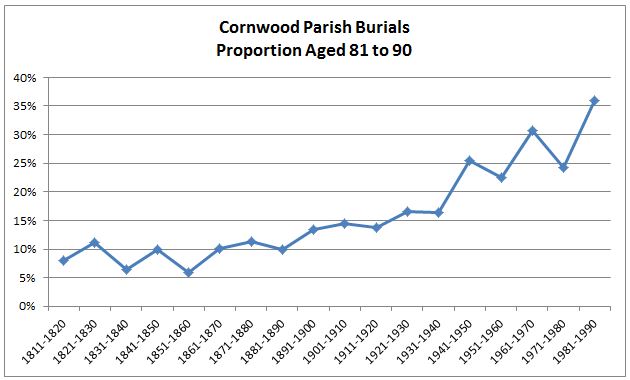
The two things we might have expected are that death among children would have declined and the average age at death might have climbed over the last two hundred years. The graphs do not disappoint in that regard.
 

What did surprise me, although I should have realized this before since I have worked with the parish BMDs for so long, is that over 50% of the deaths in the decade 1821-1830 were children under the age of eleven, most under five years old. Even 30% by 1841-1850 seems high but unchecked diseases such as measles, typhus or tuberculosis, took their toll in those years, especially on the young. Similar trends exist for older age groups: the ratio for those 11 to 20 dropped from 10% in 1851-1860 to less than 1% in 1981-1990; for those 21 to 30, it drops from 14% to near zero; for those 31 to 40, from 10% also to less than 1%.

Judging by the trends shown for other age groups, there is no doubt that people lived considerably longer in the later decades. By 1981-1990, 35% of burials were of people who had reached their 80s. Another 5% were 90 or over, an age rarely seen in the early 19th century. The main working class ages, 41 to 60, stayed about the same across the years but the proportions of people aged 61 to 80 buried in the 1980s more than doubled between 1830 and 1990, as might be expected.

The decade of 1911-1920 saw a jump in the number of deaths of people from infant age to the early twenties. A number of young adults died in 1918, many of them women, so the spike might partly represent deaths from the Spanish Flu pandemic. Certainly some of the burials might also have been of servicemen who died during WWI. Most of the children died in 1911, although not all in a short time period, so that may rule out an epidemic. The sample is just too small to really know what was going on but it’s worth looking at further.

One can read a lot of things into trends of births and deaths. Analyses like this are worth doing for family historians as it may give them another perspective of life in the communities in which their ancestors lived. In Cornwood, we can say that the burial numbers reflect a growing improvement in the health of residents with small peaks generally representative of epidemics which occasionally attacked the community. Such events were rare after the discovery of vaccinations and improvements in water and waste treatment.

It was in interesting little exercise. Most of my ancestors fit right in with the averages which is why I wanted to look at the numbers to start with. Next I will review some nearby parishes that contain more urban settings, to see if similar trends exist.

Wayne Shepheard is a volunteer with the Online Parish Clerk program in England, handling four parishes in Devon, England. He has published a number of articles about various aspects of genealogy and is the Editor of Relatively Speaking, the quarterly journal of the Alberta Genealogical Society. Wayne also provides genealogical consulting services through his business, Family History Facilitated.


Tuesday, 1 December 2015

Perils of Using Family Trees in Old (or any) Publications

I have encountered family trees published in various documents over the years. Initially I relied on these histories to flesh out my own tree. As I did more research myself and dug into actual records, though, I began to realize many of these stories often had the wrong people in the wrong places. That was especially true for people who were not directly part of the ancestral line of the authors.

For example, there are three family summaries published and available, online as it turns out, for the Bullock/Bulloch family who emigrated from Scotland to Canada with later lines moving to various parts of the United States.

Two Anderson siblings, James (1822-1892), a 2nd great-granduncle of mine, and Janet (1827-1892), my 2nd great-grandaunt, married Bullock siblings, both marriages taking place in Lanark County, Ontario. Their father, Gilbert Anderson, had brought his family to Canada in 1832. I wrote about him in a post on 15 October 2013 and about his wife, Margaret Maitland on 22 Oct 2013.

I suspect that errors creep into the family histories as a result of undocumented stories passed down verbally through the generations. Descendants don’t always have the inclination to check out information written in the books they have been given, particularly, as I said, for people to whom they are not directly related. The mistakes, unfortunately, get attached to other family trees as more family historians copy the data, but also do not go to the trouble of checking and verifying it.

There are three publications available – that I know of – that described the history of the Bullock or Bullock family and, incidentally the Anderson family: 
·         Genealogy of the Bulloch, Anderson, Coleman and Knobbs Families (1910) by Hellen Knobbs Bulloch;
·         History of Hancock County, Illinois (1880) by Thomas Gregg; and
·         A Genealogy of James Bullock and Mary Hill, Latter Day Saint Pioneers by Kenneth C. Bullock, 1964.


The main problem in all of the publications is that there are no citations indicating where information was sourced.

Genealogy of the Bulloch, Anderson, Coleman and Knobbs Families – In this book, the author indicated the parents of Gilbert Anderson, my 3rd great grandfather, were John Anderson and Margaret Wilson, Gilbert’s birth year as 1794 and his birth place as Glasgow (Scotland). His death was reported by the author as 18 July 1872 (according to Ontario records it was actually 22 July 1871). I accepted the family names for a while as have many other researchers. They appear in many published family trees. The problem was that I could not find any birth, marriage or death information in Scottish records that would confirm the relationship. The write-up lists six siblings of Gilbert so that should have been helpful in finding the family. After an exhaustive search of Scottish records on ScotlandsPeople I finally found his birth entry which showed his parents as James Anderson and Janet Finlay, his baptism date as 12 October 1792 and birth place as Campsie, Stirlingshire, Scotland. Gilbert was baptized as Gabriel but his actual birth date was not recorded in the church register. From that information I did find the other five children as well, all records having the same parents’ names. So the author had the children’s names mostly right – there was one child missing from her list – but the parents wrong. Because the information had come from so far back (late 1700s) and the parents had never left Scotland, the truth had been lost in the stories that were handed down.

History of Hancock County – The write-up on John Bullock, now with a ‘k’ in his name, says he married Jennet (Janet) Anderson in 1834 but gives no details of her family. The account also says he was born in Western Canada although it should actually have said Canada West, which was later to become the province of Ontario. The marriage was actually in 1844 as Jennet or Janet would only have been seven years old in 1834.

A Genealogy of James Bullock and Mary Hill – There is a write-up for Janet Bullock, who married James Anderson in 1848. It notes he was born “abt. 1826, of Lanark, Ontario, Canada” and was the son of Gilbert Anderson and Margaret Maitland. The parents’ names are right but he would have been born in Scotland since the family did not arrive in Canada until 1832. While there was a Lanark County, there was not a Canada or a province of Ontario until 1867.

In the same book the write-up for John Bullock indicates he married Janet Anderson who was born “15 May 1827, Kirkintillock, Dumbartonshire, Scotland [sic]” and was the daughter of Gilbert and Margaret. One problem is that no birth/baptism records can be found for Janet in Kirkintilloch, Dunbartonshire, or for two of her brothers, John (b. 1829) and Robert (b. 1832). While the family may well have been there from 1827 to 1832, I have not found any register of the births anywhere. One daughter was born in Kirkintilloch in 1826; we have that record. We know they arrived in Canada in 1832 from a number of sources (US censuses, obituaries, death records, etc.). John Bullock was shown to have been born in Campsie, Stirlingshire, Scotland. The Anderson family lived in the Campsie area as well where their first two children were born suggesting the families may have been acquainted before they came to Canada, although it was reported the Bullocks emigrated in 1819. Janet’s birth date must come from family lore. It is recorded on her grave stone and may be in a family bible but I have not yet seen any formal document confirming the date.

Books like these can be useful as they may point a family historian in the right direction initially but they can also be very misleading as they very often do not have references or citations that will allow a reader to check dates, places and names. The summaries often come down through the generations verbally as well and mistakes can certainly be made in final transpositions of the stories.


Wayne Shepheard is a volunteer with the Online Parish Clerk program in England, handling four parishes in Devon, England. He has published a number of articles about various aspects of genealogy and is the Editor of Relatively Speaking, the quarterly journal of the Alberta Genealogical Society. Wayne also provides genealogical consulting services through his business, Family History Facilitated