Tuesday, 10 June 2014

Passenger Ships – Part 3

In my last two posts I gave information about how my grandfather and great-grandfather arrived in Canada. Other family members also came by ship, some of which vessels had interesting histories themselves. In the next two posts I will describe the passage of my wife, Linda’s uncles and parents to Canada.

Name
Relationship to Linda
Ship
Date Departed
Date Arrived
Departure Port
Arrival Port
John Walker Cooper
Uncle
SS Athenia
17 September 1926
26 September 1926
Glasgow
Quebec & Montreal
Jessie Walker Cooper
Mother
SS Athenia
8 August 1930
17 August 1930
Glasgow
Quebec

The first to arrive was John Walker Cooper, Linda’s mother’s brother, aboard the SS Athenia, in 1926. John, or “Jackie” as he was known, was one of the Cossar boys, who were relocated to a farm near Gagetown, New Bruswick from Scotland, by Dr. George Carter Cossar, as part of a plan to give them a better life and a more hopeful future. I wrote about Jackie and the Cossar program in an article in Canadian Stories, An Anthology of British Home Child Stories, published in 2012 (Janzen, Ed & Susan, Editors).

Part of the article described their new home: “Cossar Farm or the Cossar Farm, Receiving Home and Distributing Centre for Scotch Lads, as it was officially called, was one of many such establishments set up to house and “train” over 100,000 child immigrants sent to Canada as ‘Home Children’ between 1869 and 1939 (Kohli, 2003). Over the years the farm operated, some boys came voluntarily, looking for a better life.  Others were sent there as punishment for bad behaviour at home.”

John made the trip with other boys of similar age, as shown on the passenger manifest. Five were listed on the outgoing list, with the last address in Scotland shown as c/o Doctor Cossar, 23 Monteith Row, Glasgow. Only four are shown on the incoming record of the Canadian Immigration Service and one of those with a different surname, indicating either a switch in boys or an error in the record.
 
Part of passenger manifest for SS Athenia on its voyage from Glasgow to Montreal in 1926; showing five Cossar Boys including John Cooper – copyright The National Archives (UK) 
(downloaded from Ancestry 26 October 2008)
Linda’s mother, and John’s sister, Jessie Walker Cooper, came to Canada four years later, also on the Athenia. She was part of a group of women destined for many parts of Canada most of whom would work in domestic service to pay off their passage. According to the Canadian Immigration Records, Jessie’s final destination was to be the Canadian Women’s Hostel in Calgary, Alberta. Travelling on the same ship were five other women originating in Scotland who were also to be put up in the hostel in Calgary and all of whom were to be employed in domestic positions.
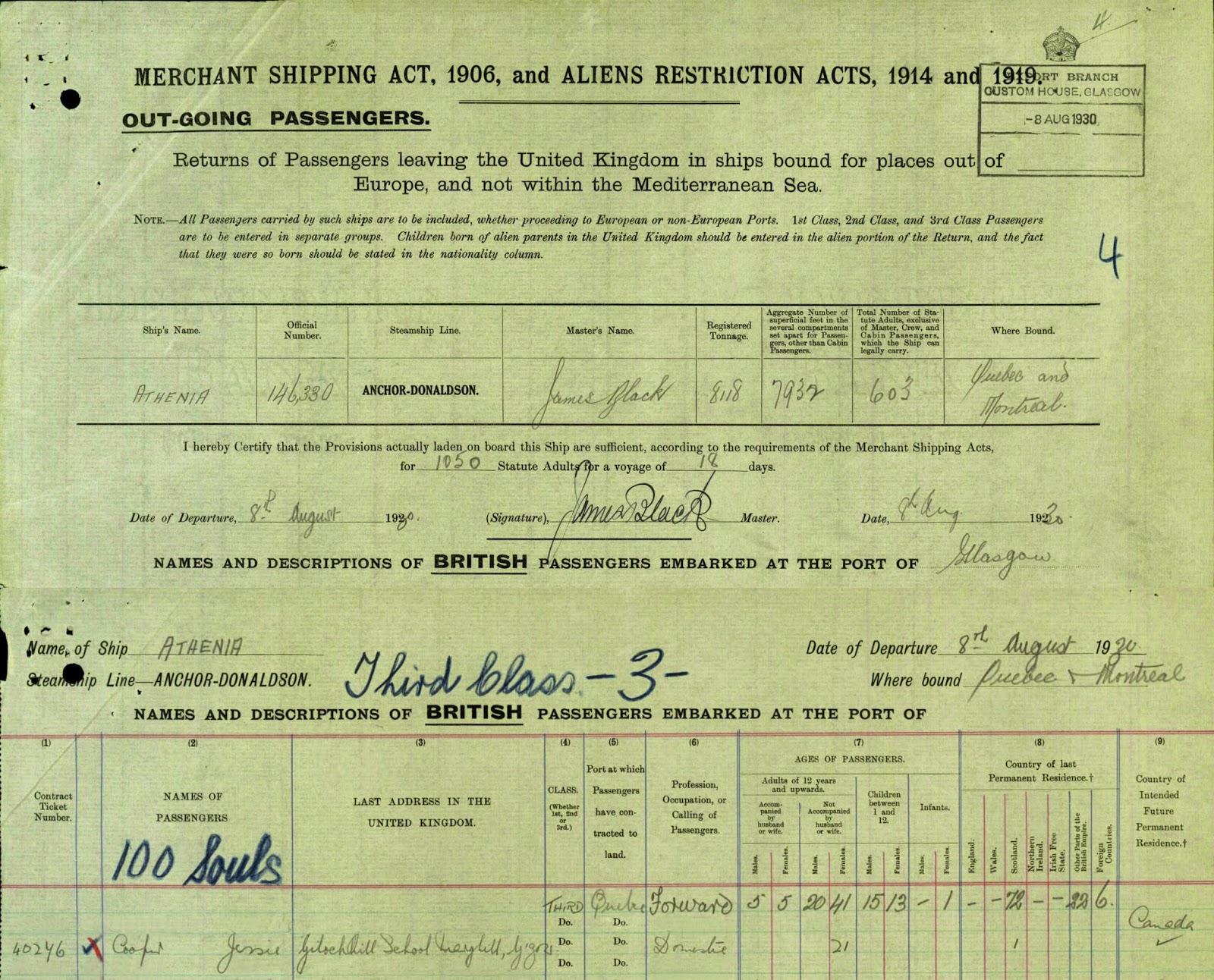
 
Part of passenger manifest for SS Athenia on its voyage from Glasgow to Montreal in 1930; copyright The National Archives (UK) (downloaded from Ancestry 26 October 2008)
John Walker Cooper & Jessie Walker Cooper, Glasgow, ca 1913 (photo from family collection)
Jessie met her future husband, William Alexander McKay, shortly after arriving in Calgary. They were married there 31 July 1931. John Walker Cooper stayed in New Brunswick and married Lillian Marlene McKee on 21 November 1941.

The SS Athenia was built by Fairfield Shipbuilding and Engineering Company, Ltd. and launched om Govan, Scotland in 1923. She was of modest size at 13,456 tons, and could carry 516 cabin-class passengers and another 1,000 in 3rd class. The Athenia was a steam-pwered, twin propeller vessel and could travel at 15 knots. The voyage from Glasgow to Montreal took only nine days. The ship was operated by Anchor-Donaldson Ltd. on its British-Canada route.
 
Photo of SS Athenia in Montreal, Canada harbour – copyright Library and Archives Canada 
(downloaded from Wikipedia 5 June 2014)
The Athenia was the first ship sunk by the Germans at the start of the Second World War. In that respect it has a marked position in history. The attack occurred on 3 September 1939, while the ship was en route from Glasgow to Montreal, 60 miles south of Rockall, Ireland. She carried 1,103 passengers and 315 crew members. Several ships in the area rallied to aid the stricken vessel managing to save all but 117 of those on board. Many of the fatalities happened during the rescue process.

Reports of the sinking made headlines around the globe and the event became a rallying point for support of the Allies and the war against the Nazi regime. Of the sinking itself, the commander, Oberleutnant Friz-Julius Lemp, claimed the ship was travelling “dark” and steering a zigzag course suggesting it was a troopship or armed vessel. He was exonerated by Hitler who decided no public reports should be made about the sinking for political reason.

References:
Janzen, Ed & Susan (Editors). (2012). Canadian Stories, An anthology of British Home Child Stories. Guelph, Ontario: Gentle Edge Publishing Co. Ltd.

Kohli, Marjorie. (2003). The Golden Bridge, Young Immigrants to Canada 1833 to 1939. Toronto, Ontario: Natural Heritage / Natural History Inc.

Wikipedia – SS Athenia    http://en.wikipedia.org/wiki/SS_Athenia

Wayne Shepheard is a volunteer with the Online Parish Clerk program, handling four parishes in Devon, England. He has published a number of articles about various aspects of genealogy and is a past Editor of Chinook, the quarterly journal of the Alberta Family Histories Society. Wayne also provides genealogical consulting services through his business, Family History Facilitated.

Wednesday, 4 June 2014

Passenger Ships – Part 2

In my last post I gave information about how my grandfather arrived in Canada. Other family members also came by ship, some of which vessels had interesting histories themselves.

Name
Relationship
Ship
Date Departed
Date Arrived
Departure Port
Arrival Port
James Shepheard
Great-grandfather
SS Ascania
27 Feb 1913
11 Mar 1913
Southampton
Portland, Maine
 
Portions of the outgoing passenger manifest for the SS Ascania, leaving Liverpool on 27 February 1913 – showing passenger James Shepheard (from Passenger Lists Leaving UK, 1890-1960; copyright The National Archives (UK); image downloaded from FindMyPast 31 May 2014)
The information on the passenger manifests for my great-grandfather, James Shepheard, was quite detailed. In particular, the immigration form listed quite a bit about him and his destination, not all of it entirely correct:
1.      Ticket number – 3196
2.      Name – James Shepheard
3.      Age – 47
4.      Sex – male
5.      Previous visit to United States – no (He had actually visited the US as a crew member on at least one earlier date. His personal bible was shown to have been purchased in New York in 1912 while he was there and working on the SS Usk.)
6.      Occupation – Ship’s Steward
7.      Future permanent residence in Canada – yes
8.      Literacy – could read and write
9.      Nationality – England
10.  Race/People – English
11.  Last permanent address – Cardiff, England
12.  Name and address of nearest relative in country of origin – brother, Cardiff, South Wales
13.  Final destination – Irricana, Alberta (had a ticket to final destination)
14.  Passage paid by self
15.  Carrying $20 in cash
16.  Person to join at final destination – brother, Irricana (It was actually his son, James Pearson, that James was intending to rejoin.)
 
Portions of the incoming passenger manifest for the SS Ascania, arriving Portland, Maine 11 March 1913 – showing passenger James Shepheard (from Atlantic Ports Passenger Lists, 1820-1873 and 1893-1959; copyright National Archives (USA); image downloaded from Ancestry 17 January 2009)
The SS Ascania was built in 1911 by Swan Hunter & Wigham Richardson Ltd. of Wallsend, England and operated by the Cunard Steamship Co. Ltd. The ship was of modest size at 9,121 tons. During the First World War, the ship carried soldiers from Canada and the United States to Europe. She sailed only for a few years, running aground and wrecked on 13 June 1918 in the Cabot Strait, 20 miles east of Cape Ray, Newfoundland. A second ship named Ascania was launched in 1923 and sailed for the Cunard line until its retirement in 1956.
 
Postcard picture of RMS Ascania, circa 1911 (image downloaded from website about Rhiw, Wales www.Rhiw.com 1 June 2014)

Wayne Shepheard is a volunteer with the Online Parish Clerk program, handling four parishes in Devon, England. He has published a number of articles about various aspects of genealogy and is a past Editor of Chinook, the quarterly journal of the Alberta Family Histories Society. Wayne also provides genealogical consulting services through his business, Family History Facilitated.

Tuesday, 27 May 2014

Passenger Ships – How our ancestors travelled to their new home

Most of the ancestors of North Americans, outside of the native population, arrived in the New World by ship. Tracking down just when and on which vessel an individual of family sailed is an exercise all genealogists go through. Often the ships, themselves, have very interesting histories, which adds to the narratives about the people who ventured out in search of a new life.

My father wrote an account of the Shepheard family for KIK Country, a compilation of stories by descendants of people who has settled in the Kathyrn-Irricana-Keoma area of Alberta published in 1974. He stated that his father, James Pearson Shepheard, had arrived in Canada, at the age of 17, in 1907, working first at “Meamington, Ontario” and then coming west to Alberta in 1909. So I had a sailing date and a destination. One problem with the information is that I have never found a place called Meamington.

One can find information about passenger records to Canada in a number of places. Library and Archives Canada has copies of records of immigrants to Canada and the ships on which they arrived. The National Archives in Britain has information on emigrants to many parts of the world which can be searched in their catalogue.  The Ships List website has a substantial amount of information on passengers and vessels. Subscription sites, such as Ancestry and FindMyPast  also have actual images of the passenger manifests. Not all are indexed and even some of those that are contain errors.

After searching a number of databases, I finally found my grandfather on the passenger manifest of the RMS Empress of Britain, which left from the Port of Liverpool on 14 June 1907, arriving in Quebec on 21 June. Of course he was shown as J. Shepherd, a farmer, aged 19, which complicated the search.
 
Portions of the outgoing passenger manifest for the SS Empress of Britain, leaving Liverpool on 14 June 1907 – showing passengers James Shepherd and Charles Salter  (copyright The National Archives; image downloaded from FindMyPast 20 August 2012)
After a roundabout search, I found him on the incoming passenger records as well. He was indexed on the Ancestry list as James Shephard, born 1898! On the actual image, though, his age was the same as the outgoing manifest – 19. More particular were found on the immigration list, though, including that he was a dairy farmer, born in England, last lived in Somerset and whose destination was Napanee (Ontario).

Portions of the incoming passenger manifest for the SS Empress of Britain, arriving at Quebec on 21 June 1907 – showing passengers James Shephard and Charles Salter (copyright Library and Archives Canada; image downloaded from Ancestry 20 August 2012)
He was also shown with the designation “Com. Paid C. G. E. A. No 1947 British Bonus Allowed” and travelled in Steerage. The British Bonus was a commission paid by the Canadian government's Immigration Branch to steamship booking agents in the United Kingdom for each suitable immigrant who purchased a ticket to sail to Canada. C.G.E.A. was the abbreviation for Canadian Government Employment Agent. They also received a commission from the government for placing newly-arrived immigrants with employers who were seeking labourers or domestics.

Both James and a fellow passenger, Charles Salter, also supposedly aged 19, were headed to Napanee. A postcard sent to James from his friends at the Shepheard Dairy in Somerset, in October 1907, is addressed to him “c/o Mr. W. J. Bowen” at Deseronto Post Office. Deseronto is only 11 km from Napanee. Very likely both James and Charles ended up working for the Bowen family. I suspect that the fares of both boys may have been paid by the Bowens and that they had to work off the debt on the farm before they could move on.

The RMS Empress of Britain was a 14,189 ton vessel, built for the Canadian Pacific Steamship line by Fairfield Shipbuilding in Govan, near Glasgow. It was launched on 11 November 1905 with her maiden voyage from Liverpool begun on 5 May 1906.

SS Empress of Britain at Liverpool in 1905 – photo part of E. Chambré Hardman Archive (downloaded from Wikipedia 21 September 2013)
Postcard of the SS Empress of Britain, pre 1924 – original now in Liverpool Record Office (downloaded from Wikipedia 21 September 2013)
The ship could carry up to 310 first-class, 470 second-class and 730 third-class, or steerage passengers. She regularly traversed the Atlantic between Canada and Europe, except during the First World War, until 1922. During the war, she was re-fitted to become a merchantman with the British Admiralty. The Empress also struck an iceberg, just two weeks after the sinking of the Titanic in 1912, however damage was reported as only slight. In 1924 the ship was renamed SS Montroyal. She carried her final passengers in 1929. A second, much larger ship, at 42,348 tons, was also named RMS Empress of Britain and launched in 1930. It was torpedoed and sunk by a German U-boat in 1940. A third RMS Empress of Britain, of 25,516 tons, was built in 1955. More information about the ships can be found on Wikipedia.

One can only imagine the excitement and possibly trepidation of a teenage boy, with limited resources, leaving family and home for a new adventure thousands of miles away. In the end he was very successful in establishing a new life and raising a family in Canada. I do wish, though, that I had known enough to inquire about his early life in Canada so that I could have learned about his travels and his decision to leave England. He and my father both passed away before I really got deeply involved in genealogy and knew the value of asking questions of those who were part of our family’s history.

Wayne Shepheard is a volunteer with the Online Parish Clerk program, handling four parishes in Devon, England. He has published a number of articles about various aspects of genealogy and is a past Editor of Chinook, the quarterly journal of the Alberta Family Histories Society. Wayne also provides genealogical consulting services through his business, Family History Facilitated.