Wednesday, 21 August 2013

Thanks to the Volunteers


As I indicated in an earlier posting, with the help of many volunteers, we have been able to transcribe thousands of pages of parish registers and other documents for my four parishes in Devon to date. And work is still ongoing!

Volunteers are, of course, the lifeblood of genealogy. While commercial firms have been of great benefit in being able to find indexes and images of old records, much of what we all use is a result of thousands of volunteers each spending countless hours poring over and transcribing old documents.

I want to acknowledge here all the individuals who have assisted me: Alick, Bob, Brian, Bronwyn, Catherine, Chris, Cindy, Ellie, Gina, Joan, John, Laura, Linda, Noreen, Pamela, Sue and Vivian. I haven’t used their last names here for privacy reasons but they will recognize themselves if or when they find my blog.

As I also said before, I like to get my data in an organized form for easy reference. I have spreadsheets containing the names and dates of all individuals who were baptized, married and buried in my parishes, from the early 1600s to present day. I can sort these lists and come up with summaries of entire families over several generations.

Just for the Shepheard family in Cornwood parish, there were 124 baptism entries (see table below), 47 marriage entries and 90 burial entries in the parish registers between 1685 and 1995 That is not an overly large number compared to some other families but it represents 40 individual families related to me and spans 8 generations.

Our surname has been recorded with several different spellings but, by combining the data from the BMD registers, censuses, tax lists and other documents, I can show that, in that parish at least, they were almost all related. One unrelated Shepheard family did move into the parish in the late 1800s and an occasional person with a similar name appeared to get baptized, married or buried there, but these can all be easily differentiated from my ancestors in the lists. I can also show the history of all those other families who intermarried with the Shepheards and who are also my ancestors, as well as those who didn’t match up with a Shepheard, of course.

This is the list of Shepheard children baptized in Cornwood parish between 1685 and 1993. It contains information on the children’s and parents’ names; date of baptism, and occasionally date of birth; residence location; fathers’ occupations; and, for a few children, their illegitimate status. Readers will not be able to distinguish details but it serves as an example of what I can do with transcribed data from the parish registers. This list is sorted by (1) surname and (2) father’s forename. Each separate family is arranged together. From the list I can then match marriages, burials and censuses (after 1841) and compile a rough, initial “history” of the various families.

Having the data organized in this manner allows me to do many different analyses that help with unravelling the parish history as well as the lives of the residents. I will discuss some of these discoveries in later posts.

The point is that, segregating families over many decades would not be possible if we did not have complete lists of BMD entries from the transcription of parish registers. And we would not be anywhere near having those lists available to for our research without the help of so many people.
 
So, again, a big thank you to all those who volunteered, and continue to volunteer to help!

Saturday, 17 August 2013

How I Became an OPC


I had no knowledge of the Online Parish Clerk (OPC) program when I first started my genealogical investigation of British records. It started off innocently enough when I went to find out more about my direct-line, paternal ancestors.

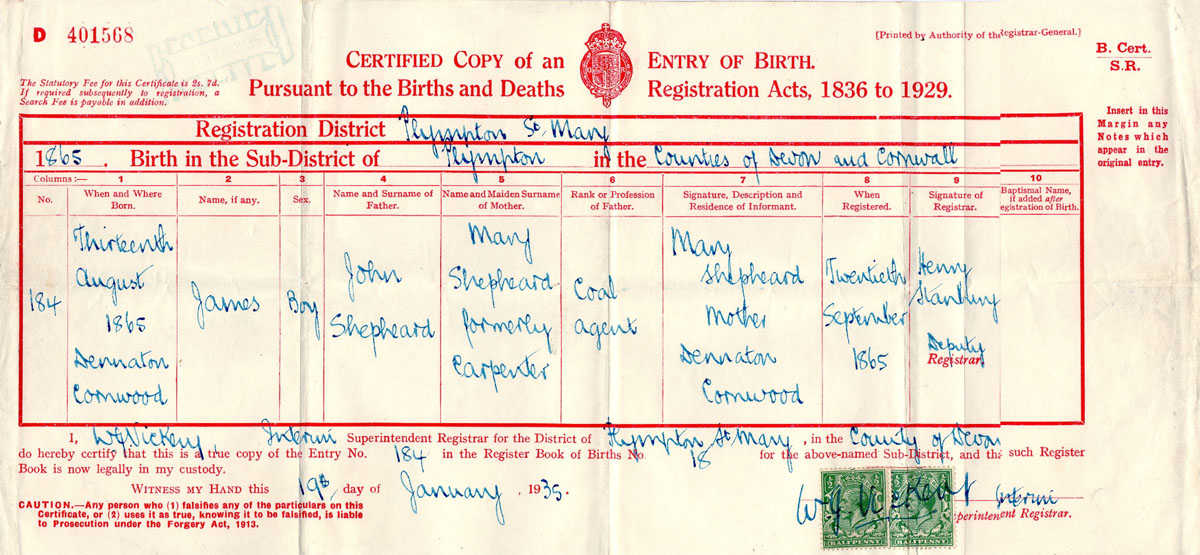
From a few bits of information I had about my Shepheard line, including two birth certificates inherited from my father, I knew my grandfather had been born in a place called Torquay in Devon, England, and his father had been born in “Dennaton, Cornwood” (wherever that was), in the “Sub-District of Plympton in the Counties of Devon and Cornwall.” The birth certificate issued by the General Record Office for my great-grandfather is shown below.

These documents gave me a couple of starting points for what would become a very long and still-not-ended journey. The reference to Cornwood, though, clued me in on where my initial searches should be concentrated.

I was feeling flush and adventurous when I finally got seriously involved in genealogy. One of the first things I did was purchase all of the Cornwood parish birth/baptism, marriage and death/burial registers which were available on microfiche. I thought that might be the best way to discover information about my family – go through all the registers myself and find the actual entries pertaining to the individuals. I had my own microfiche reader/printer so it was no problem to order and use the films at home.

At the time, I did not realize how lucky I was going to get. It turned out that my ancestors had lived in the Cornwood area as far back as the early 1600s so I was about to discover hundreds of them, over eight generations, hidden in the registers.

Interestingly, when I found my great-grandfather’s baptism entry, there was very little information shown. Without the birth certificate I would only have been able to identify him at the time from census data. The Vicar appears to have lost his notes when it came time to fill in the page in the baptism register, as can be seen in the image below! Information for one other child baptized the same day was also missing.


1865 September 5 – baptism entry for [James} Shepherd [sic], in Cornwood parish baptism register #823/4, page 42; image accessed from FindMyPast March 5, 2010, copyright Plymouth West Devon Record Office

This is one of those curious situations that can be encountered occasionally with old parish records. One has to work around them, using other sources, in order to find the full information about some individuals. James did appear on the England census for the first time in 1871, at the age of five. His family were then living in Ermington Parish, very near that place called Dennaton, Cornwood. In any case, all other Shepheard children born around this time were identified in the register leaving me to conclude that the incomplete record had to be for James.


Portion of 1871 England Census enumerator’s sheet, page 2, folio 53, piece 2107, class RG10;
showing John Shepheard family living in Ermington Parish, Devon;
 image accessed from Ancestry November 3, 2006, copyright The National Archives

I did finally put together almost everything I have learned about my Shepheard line in Devon, in a book that was distributed to many family members last month. The early reactions from some of them are amazement of what all I have found out and delight in seeing the history of the family laid out. It inspires me to keep going with my other lines.

As many people have found in their research in England, indeed, Great Britain, parish registers are among the more important sources of information about people. They contain the basic data on individuals – births, marriages and deaths – over long periods of time. Not all registers are complete, or have been preserved for every parish, and not all individuals who were born in the various parishes were baptized, married or buried there. But the registers do provide an excellent initial source to search for ancestors.

I always like to get my data in an organized form; so, from the beginning, I started transcribing all the register entries and putting the information on spreadsheets. Shortly after receiving the fiche, I decided I could probably help others find their ancestors, since I now had the data in hand. That’s when I volunteered to become the OPC for Cornwood. Before long I had also purchased the fiche for the registers of the adjoining parishes of Harford, Plympton St. Mary and Plympton St. Maurice (I said I was feeling flush in those days) and took on those parishes as well.

Over time, and with the help of many other volunteers, we have transcribed almost all of the BMD registers from my four parishes – now over 70,000 individual entries from over 7,400 register pages. We have also done most of the censuses in the area, another 31,000 entries from over 2,300 pages. From that work, I have a searchable database that speeds up answering questions from other researchers. Having the information on a spreadsheet also allows me to sort the data and recombine it to show individual family summaries, over many generations in some cases.

I have had hundreds of queries, from people all over the world, looking for information about their families who lived in my parishes or somewhere in Southwest Devon. Most I have been able to help by providing BMD, census and other data that filled in missing pieces of their family history and even broke down a few brick walls. It is always gratifying to be able to assist people in discovering their ancestors and give them more avenues in which to search.

Some of the queries have resulted in some very interesting and surprising stories, many of which I will discuss in later posts.

Wednesday, 14 August 2013

The Online Parish Clerk (OPC) Program


As I related previously, a lot of what I have learned about family history in general and my family members in particular come from my experiences as an Online Parish Clerk (OPC). I became the OPC for Cornwood Parish, in Devon, England, in 2003. The program was very new then and I had no idea what it meant or how it might end up consuming me. I also would never have believed how much I could learn as an Online Parish Clerk.

In future posts I will comment on how I got involved and also offer some examples of the interesting and often surprising stories I have come across in reviewing data in parish records and answering queries from other family researchers.

Much of the following is from my article, The Future is Still in the Past: An Introduction to Online Parish Clerks, published in Crossroads, the quarterly journal of the Utah Genealogical Association, in their Summer 2012 issue. Another paper about the OPC program called, simply, Online Parish Clerks, was written by Roy Stockdill and appeared in the April 2012 issue of Family Tree. Both offer good summaries of what the OPC scheme is all about. They can also both be read on my Cornwood-OPC website.

England is divided into 40 administrative counties which traditionally were each comprised of various numbers of ecclesiastical parishes. Each parish had its own church that administered to both the spiritual and the secular needs of the community.

In 1538, Thomas Cromwell, chief minister of Henry VIII, issued The Second Henrician Injunctions that mandated every parish to maintain registers in which to record all baptisms, marriages and burials. These documents are central to ancestral research in England but it is not always practical for researchers to inspect or study the original registers or the many additional documents that originated in the parishes. Some of the people offering assistance in sourcing and reviewing the parish information are those involved in the OPC program.

There is no formal structure to this unique program. Each county that participates organizes its own network of OPCs. Interested individuals volunteer to oversee a parish. A coordinator assists them in setting up their areas and organizing their data in whatever way suits them best. A major stipulation is that OPCs will share their knowledge with others free of charge. They must also be accessible through email contact.

The tasks of OPCs are primarily to compile reference material for their adopted parish or parishes in the form of transcripts, extracts, abstracts, indexes and copies of original records. Data is collected from as many sources as possible, emphasizing both local history and genealogy. Many OPCs maintain websites where data may be stored for browsing or source references may be listed.

Although OPCs are not officially associated with parish councils, ministers or congregations, these groups are often helpful in sourcing information about past residents and constructing histories of the various parishes. Close contact with incumbents, parish clerks and churchwardens is always desirable.

The OPC concept originated in 2000 with three genealogists who had been researching their families in the southwestern County of Cornwall. After discussions about organizational matters, they began their project in 2001. A comprehensive description of the OPC program, and the objectives envisioned and drafted by those early volunteers, can be found on the Cornwall OPC website.
Over the past decade the scheme has spread to a number of other counties in England, as shown in the following table. The table summarizes the OPCs active as of March 2012.

County
Total Parishes
Parishes with an OPC
Number of OPCs
% of Parishes with OPCs
Cornwall
260
255
121
98%
Devon
474
201
93
42%
Dorset
297
156
87
53%
Essex
263
46
23
18%
Somerset
506
152
78
30%
Sussex
430
94
53
22%
Warwick
431
86
34
20%
Wiltshire
253
118
59
47%


In most counties individual OPCs take care of parishes. In a few counties, a coordinator collects transcriptions and other material for the entire county from many volunteers (individually referred to as OPCs). Among these are Kent, Lancashire and Hampshire.

It is not uncommon for an OPC to handle more than one parish. Families often crossed parish boundaries for work or other reasons; so, naturally, researchers may need to study material in adjacent parishes for information about their ancestors. Many OPCs, like this writer, live outside of the UK while researching their British roots.

OPCs must consider copyright restrictions, data protection and privacy issues in disseminating information and, to the best of their ability, avoid any misuse of data such as publishing private information or providing data about living people.

Because OPCs have generally spent a great deal of time examining and transcribing records, we will usually have a broad view of the community and of the individuals and families that lived in the parishes. We are thus able to pass along very helpful advice to people trying to build their own family trees or learn about the areas in which their ancestors lived.

While we are moving rapidly into an era that utilizes the Internet and a vast array of technical assistance in collecting, organizing and storing information, future research and the construction of family trees is still primarily based on information from the past. Volunteers like OPCs can and will be sources for much of that data.

If anyone has an interest in helping, there are still lots of areas that could use more volunteers. Contact the coordinator in the county in which you have knowledge, expertise or just a general interest and become an OPC!