Tuesday, 29 December 2015

Do “Informants” really know everything they should?

Information on many formal documents of birth, marriage or death is given to authorities by “informants” many of whom may not always be members of the concerned individual’s immediate family. The people who are relied on to provide important individual and family information can and often do make mistakes in spelling of names, dates, places of birth, etc. Even people who should or might know better can have lapses.

I was reminded of this subject by friend whose son phoned her recently for information he needed to put on a passport application concerning her birth place, her husband’s birth place, the location of their marriage, etc. As a dedicated family historian she was quite appalled by his lack of knowledge; his brother was apparently not much better informed. Then, on Christmas Eve, a cousin phoned to ask her what his own mother’s maiden name was exactly. She hoped he was not the informant for her death record information.

Having set her son straight, she did what many of us should probably do – she went to a local funeral director and picked up forms they use to record all personal information of the deceased. She has filled them in for herself and her husband and lodged them with the funeral directors so that no one makes any simple mistakes on her or her husband’s formal death records. Now she just has to make sure her children know where the information is.

I have seen many errors when poring over many old church records for my family and for others in the Devon parishes I look after as an OPC. But I have also come across instances in more recent civil records where the information was not accurate, this information supposedly given to authorities by knowledgeable informants.

My own father signed the Registration of Death for my mother on which her second name of Mabel was misspelled as Mable. It was just a small thing and I suspect he knew better but he was probably distracted at the time and did not read it all as closely as he should have. I have since had the information corrected in the government records.

Information on birth records can usually be relied on as it is most often provided by one of the parents. I do not have a formal birth certificate for any member of my family that contains an error but that does not mean there may not be some out there that do.

Marriage certificates are generally expected to be correct, at least in terms of who the bride and groom were and what were the names of their parents. People do make mistakes, though, even when writing out names of people they know. My parents’ marriage certificate shows his father’s middle name as Pierson instead of Pearson. The marriage record for my wife’s parents incorrectly shows his mother as Mary Mill instead of Mary Milne.

Most documents with my maternal grandmother’s name show her as Mattie, which she went by, rather than her formal name of Martha Alwilda Jane. The official records, in my view, are not entirely complete then. Interestingly, on Grandma’s own marriage record in 1895 the name of her mother was recorded as “unknown”. I suspect she never saw this document so the omission went undetected.

When the 1914 marriage of my paternal grandparents was registered in Calgary, the day after the ceremony, his mother’s maiden name was typed as Mary Reasson instead of Mary Pearson (a big mistake in my mind) and her mother was recorded as Marguerite instead of Margaret.

My mother’s death record was not the only one I found a mistake on. On the Alberta Registration of Death of my maternal grandmother, my mother, who signed the form, named her as just Mattie, again, rather than with her full name.  She also indicated her maternal grandmother was “unknown Deburko”. The last name should actually have been Debusk, which she may not have known or possibly did not remember at the time. Her grandfather was recorded on the same record as Asa McDaniels instead of McDaniel. On the Alberta Registration of Death for my maternal grandfather, signed by my uncle, my great-grandfather’s name appears to have been typed as Hiller rather than correctly as Miller. The name of my great-grandmother was hand-written in as “not known”. It is curious that neither of my mother’s grandmothers’ names were known when these forms were completed.

The 1965 British Columbia Registration of Death for my paternal grandfather showed his mother as Elizabeth Pearson. Her name was, in fact, Mary Elizabeth Pearson so forms showing either forename are technically although not completely correct. The inevitable mistake happened on my paternal grandmother’s 1959 British Columbia Registration of Death: her last name was recorded as Shepherd – as was her husband’s! The Certificate of Death, from the Department of Health and Welfare, Division of Vital Statistics has the same misspelling. I have not yet been able to decipher the signature of who signed the registration document so cannot accuse a family member.

I have probably seen more mistakes in information given by people about themselves on government documents, many likely intentionally done. Censuses are something where many people lied about their ages to start with. Birth places can also be suspect as whoever was giving the enumerator the data often did not know the correct details, or in England at least put down names of towns instead of parishes. Sometimes I think that they just did not always feel like sharing everything about their personal lives with the government.

My wife’s grandfather, Alexander Cooper, was married twice, in both instances misnaming his parents. On the record of his first marriage he gave his father’s name as William Cooper and his mother’s as Elizabeth Cooper, nee Spence. On his second marriage he gave his father’s name again as William Cooper but this time his mother’s maiden name was shown as Lawrence. Alexander was actually illegitimate, so we do not know who his father was. He quite possibly did not either. His mother’s maiden name was, of course, Cooper.

Alexander’s death record also shows his father’s name as Cooper and mother’s maiden name as Lawrence. That one was signed by one of his daughters who apparently was never told the entire truth about his circumstances. On his military service record he indicated his father was John. No last name was shown so we are led to assume it was Cooper. He did have a step-father by the name of John Blackburn. The address given for his father on the attestation record is not consistent with that of either Blackburn or his mother at the time Alexander went into the army, though, so we cannot be sure of its accuracy or what Alexander intended when he filled out the form.

We rely on many formal documents in assembling our family history. All of them are produced by people using information they got from other people, so mistakes are bound to happen.

One lesson here may be to never believe everything you read about people, unless you see it recorded in several different documents. Even then there could be problems, of course, but the more documents that can be found where the same information is recorded, the more reliability there can be for it. Most of the examples I have given here are quite modern ones which I might have expected would have been more accurate. Many of them illustrate that, as in my friend’s experience, children do not always know everything about their parents that you might think they should.


Wayne Shepheard is a volunteer with the Online Parish Clerk program in England, handling four parishes in Devon, England. He has published a number of articles about various aspects of genealogy and is the Editor of Relatively Speaking, the quarterly journal of the Alberta Genealogical Society. Wayne also provides genealogical consulting services through his business, Family History Facilitated.

Tuesday, 22 December 2015

The Stockings Were Hung . . .

Most blogs this week have great Christmas themes, from pictures of decorated trees of the past to names of ancestors some family historians would like to have as guests for dinner, to ideas about getting all that information from family members assembled together to celebrate the season.

OK, I won’t disappoint. This one is about Christmas stockings, hung with care in hopes of. . . (with apologies to Clement Clarke Moore).

In the hundreds of photographs in my dozens of family albums, I thought I had many pictures of stockings hung on a fireplace or a reasonable facsimile from past Christmases. I was wrong. There were many trees, all decked out, most with presents scattered under them following Santa’s visits and before children got to them. But there were only a few showing stockings. The earliest I could find – 1974 and 1975 – were taken after all three of our children had arrived. The stockings were pretty basic models to start with but they got more elaborate as the years went on.


By 1983 we all had personalized stockings made by my wife, Linda, each with bright Christmas-print fabrics.


When our children were married, Linda made additional stockings for the new members of the family.


I was curious, as many others are, about how this tradition got started. I don’t recall ever looking into the history before. It never seemed to be important. Only the happy faces of children (and many adults) when they came upon them Christmas morning was what counted. So, like all modern researchers, I looked it up on the Internet.

A 2012 article written by Emily Spivak for the Smithsonian caught my attention, highlighting the story and showing pictures of stockings going back many decades. She related the common story about the origin as being St. Nicolas (the Bishop of Myra at the time) sneaking into the home of a widower with three daughters and putting gold coins in their stockings, which had been hung by the fireplace to dry. The gift meant they then had the wherewithal to attract husbands. I know dowries used to be important but were men so shallow back then that they needed their brides to bring a little cash with them? 

Anyway, versions of this story have been told for generations now. If it is even close to the truth, then the beginning of Christmas stockings would have begun early in the 4th century, in a little village in what is now Turkey – long before there were genealogists.

There are many side stories about other traditions concerning what was or is put into stockings, too:

·         Oranges are, or were common gifts (Don’t you remember getting those juicy little Mandarin treats?). One explanation is that they are supposedly symbols of St. Nicholas as they are gold in colour.
·         Some regions use boots or shoes instead of stockings. Prior to the introduction of Christianity, Germanic children, celebrating the Yuletide period, would apparently fill them with carrots, straw or sugar for the flying horse of the Norse god, Odin. Odin in return would return the favour by leaving gifts or candy. This old, white-bearded god may have been the model for the Santa Clause we know. The horse’s name was Sleipnir, and it had eight legs!
·         A story grew up in Western Culture that bad children would be given coal in their stockings. There are no reports of it actually happening as it is a cruel thing to do and not, in any way, fitting for Christmas. Perhaps the idea was just used as an enticement to children to be good, just as we tell them today that Santa Claus is always watching to see who is naughty or nice. Or maybe it comes from the use of an Italian candy called Carbone Dolce, which looks like coal. You can find a recipe to make it yourself here.

There is an interesting article from the New York Times published in 1883 about how in the 19th century the Christmas Stocking had been supplanted by the use of the Christmas Tree – “a rootless and lifeless corpse” according to the editorial writer. The article celebrated the introduction of a new type of decorated stocking, much more in keeping with the holiday season.

Hanging Christmas stockings is a neat tradition to observe now. You don’t have to belong to any particular religion or have any specific familial origin to enjoy it and bring smiles to all family members. They are decorative as well as fun things. You can find hundreds of ideas online now about how to fill a stocking (Is that really necessary?) or what to put in them (Again, this is not rocket science!).

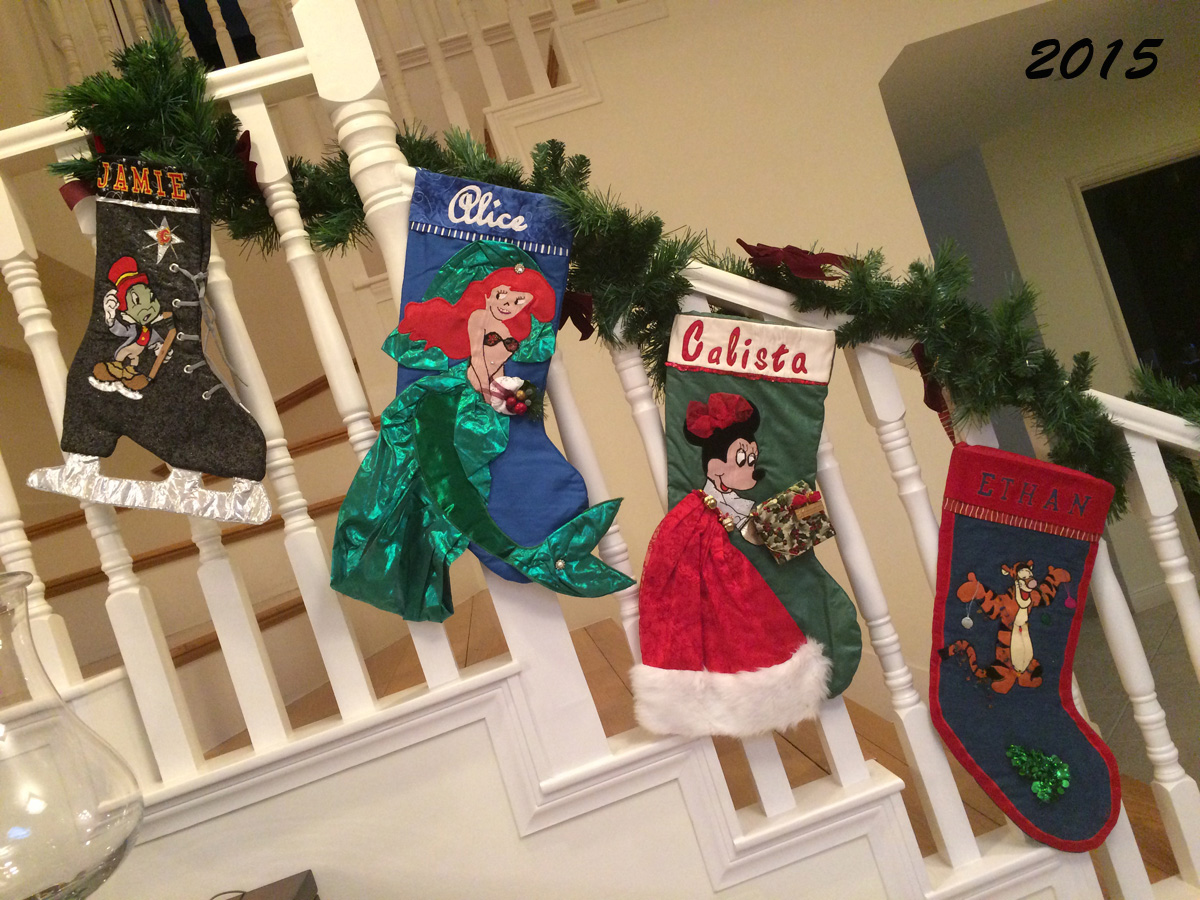
Linda, has made many stockings over the years – for our children, for brothers and sisters, for nieces and nephews and for friends, some of which are shown above. In 2007 our whole family was invited to spend the holiday with our son and daughter-in-law in Florida. While there we were also going to spend some time at Disney World. So she made a stocking for everyone who was going to be there, all with a Disney Theme – 17 of them! They are works of art as well as useful repositories for gifts. Don’t you think?


Our children still have and hang theirs each Christmas. Grandma’s stockings have become favourite additions to their seasonal décor and maybe will be family memorabilia one day, too. 

These will be filled by Santa when he makes his stop in Vancouver, Canada.


 These four are now waiting for Santa to arrive in Beijing, China.


We still have ours, now hanging on the fireplace of our new condo. I am not sure Santa will have time to come here this year, though, especially with no kids around! We’ll enjoy the season in other ways. And yes, mine is that loveable character Grumpy!


To all of my readers here, please have a very . . .

And to all a good night!

Wayne Shepheard is a volunteer with the Online Parish Clerk program in England, handling four parishes in Devon, England. He has published a number of articles about various aspects of genealogy and is the Editor of Relatively Speaking, the quarterly journal of the Alberta Genealogical Society. Wayne also provides genealogical consulting services through his business, Family History Facilitated.

Tuesday, 15 December 2015

What do your children want to know about your family history?

Many genealogists I know are starting to think about how they can interest and involve younger members of their family in their activities. Most societies are wondering where their future members will come from to continue their programs. Is that because we are all getting older and are worried about what will happen to all those years of work and the tons of information we have collected?

Whatever the reason, it’s not a bad idea to engage young family members in the pursuit of knowledge about their ancestors. They might learn something about themselves as well as about their history.

As the Editor of Relatively Speaking, the quarterly journal of the Alberta Genealogical Society, I just helped publish a whole issue dedicated to Youth and Genealogy. We had a variety of papers about how to get children started, what benefits there are to introducing them to genealogy and an outline of a new program initiated by our Society. There were even stories written by children themselves about their own backgrounds. The contributions were both interesting and informative. A list of the feature articles is at the bottom of this post.

In the process of sourcing and assembling material I learned quite a bit about what is out there for parents, teachers and others who want to show children what they do and how they do it, with respect to family history. Three genealogical societies in Canada now have programs on their websites that are helpful:

·         Alberta Genealogical Societyhttp://www.abgenealogy.ca/genealogy-for-youth The AGS Genealogical Project for Children and Youth. The first resource within this project (intended for children aged 6 to 9 years of age) has just been released on-line. Enjoy exploring!
·         Ontario Genealogical Socitey https://www.ogs.on.ca/lessonplans.php The OGS Family History Lesson Plans Project for elementary and secondary students began this past summer with the intention of connecting OGS with students by providing educational resources to educators.
·         Victoria Genealogical Societyhttp://www.victoriags.org/school/ The VGS Genealogy in the Classroom webpages provide lesson plans with resources such as printable genealogy forms and free online genealogy games.

I would be interested in hearing about other groups around the world that have similar genealogical programs for children and youth.

Anyway, back to the question I posed as the title of this post – perhaps the best way to get children started in looking at family history is to ask them what they would like to know.

How many people have you come across who have told you they wished they had asked their parents and grandparents about their experiences and personal histories? Have you muttered that to yourself as well on occasion? Now most of us spend countless hours and funds trying to find many of the answers that people we knew and grew up with might have been able to provide.

Don’t let your descendants make the same mistakes. Go ask your children and grandchildren what they would like to know about your/their family. They might surprise you by showing an interest in what you have done and learned and want to know more. Do it right now!


Here are the Feature Articles that are in the latest issue of Relatively Speaking (Volume 43, Number 4, November 2015). Let me know what other, similar papers are out there and I will help spread the word on this blog.

·         Sowing Winter Wheat: Introducing genealogy and family history to children and youth by John Althouse
John comments on the value of introducing children to the exciting adventure of family history research and introduces the new AGS project, Genealogy for Youth, which offers many resources to help teach children about their current and extended family.
·         Family Adhesive: The value of family history for children by Janet Hovorka
In this article we are shown how involving children in family history pursuits actually helps to teach them discipline, foster self-esteem and create strong relationships within the family.
·         The Search for Captain Roy Brown by John J. N. Chalmers
John relates his search for information, in particular the grave site of WWI war hero Roy Brown. At the same time a young student, Nadine Carter, was also in pursuit of the same information, and uncovered important facts about Captain Brown. This story is about her achievements as well.
·         Is Family History for Children and Youth? by Helen Gwilliam
Helen offers commentary and advice in having children participate in genealogical activities in which they can gain experiences and practice valuable skills that will help them in the future.
·         Mystery by Anne Baines
Anne’s grandson was invited to help research an ancestor and ended up finding new information that helped answer questions about the relationship between two branches of their family.
·         Immigrants to Canada: A family history project in Grade 5 Social Studies by Marion Rex
Marion introduces several student authors who put together stories of their own families for a Grade 5 class project. Their contributions are as follows:
o   Our Acker Family’s Journey to Canada by Colin Acker and Allison Martens
o   Escape From Czechoslovakia: The Bouz Journey by Leah Kinahan and John Bouz
o   Isley Family Descendants by Andrew Kennedy
·         Let Them Contribute: How today’s youth are engaging in the genealogy space by Amanda Terry and Devin Ashby
Amanda and Devin describe many programs and activities available to children and youth that help them learn about genealogical research. They also offer advice to parents and others about directly involving young people in genealogy.


Wayne Shepheard is a volunteer with the Online Parish Clerk program in England, handling four parishes in Devon, England. He has published a number of articles about various aspects of genealogy and is the Editor of Relatively Speaking, the quarterly journal of the Alberta Genealogical Society. Wayne also provides genealogical consulting services through his business, Family History Facilitated.