Tuesday, 17 June 2014

Passenger Ships – Part 4

In the last post here I wrote how my wife Linda’s mother and uncle, arrived in Canada. Her father, William Alexander MacKay, and his brother, Hugh MacKay, and Hugh’s wife, Catherine, also made the passage from Scotland. Following is a brief description of the ships they travelled on.

Name
Relationship to Linda
Ship
Date Departed
Date Arrived
Departure Port
Arrival Port
Hugh MacKay
Uncle
SS Marburn
6 June 1923
Glasgow, Scotland
Quebec & Montreal
Hugh MacKay
Uncle
SS Metagama

19 December 1926
Saint John, NB
Greenock, Scotland
William Alexander MacKay
Hugh MacKay
Father
Uncle
SS Metagama
28 May 1927
6 June 1927
Glasgow, Scotland
Quebec & Montreal
Catherine MacKay
Aunt
SS Montclare
14 February 1928
26 February 1928
Greenock, Scotland
Saint John, NB

Hugh came to Canada first, in 1923, aboard the ship SS Marburn. He apparently was to join his uncle, John McKay, who had a farm near Tregarva, Saskatchewan. John apparently arrived in Canada in 1869 but I have not yet found a passenger record for him. I have also not confirmed his exact relationship to Hugh.

Hugh returned to Scotland in 1926, presumably to marry. His return journey was on the SS Metagama, sailing from Saint John, New Brunswick and arriving in Greenock, Scotland on 19 December 1926. Hugh married Catherine Mathieson in Elgin, Moray, Scotland on 18 May 1927. Catherine came to Canada later, leaving Greenock on 14 February 1928 and arriving at Saint John on 26 February 1928, aboard the SS Montclare.

In 1927, both Hugh and William Alexander journeyed to Canada, again to join their uncle in Saskatchewan. The ship’s record shows their place of origin as Dyke Village by Forres which is in the County of Morayshire in Scotland. Dyke had been the family home for some years. They had moved there some time after 1911 from Findhorn, a fishing village about 9 miles to the northeast. Hugh and William travelled on the SS Metegama, the second time for Hugh. The ship left Glasgow on 28 May 1927, arriving in Quebec City on June 6th. Both were bound for Tregarva. William later moved to Alberta while Hugh and his family settled permanently in Saskatchewan.
 
Part of passenger manifest for SS Metagama on its voyage from Glasgow to Quebec in 1926; showing Hugh and William MacKay – copyright The National Archives (UK) 
(image downloaded from Ancestry 26 October 2008)
Parts of the incoming passenger list for the SS Metagama, arriving in Quebec City on 6 June 1926  – showing passenger William MacKay; copyright Library and Archives Canada 
(image downloaded from Ancestry 25 October 2008)
The 10,576 ton steamship Marburn was originally launched under the name, Tunisian. It made its maiden voyage for the Allan Line on 5 April 1900 from Liverpool, England to Halifax, Nova Scotia. The ship was chartered to Canadian Pacific Steamship Company in 1907 and taken over by them in 1917. In 1915 it was used as an accommodation ship for German prisoners of war, docked at the Isle of Wight. In 1918 it resumed passenger service. The ship was renamed Marburn in 1922. She was finally scrapped in 1928.
 
Postcard picture of the SS Tunisian, later renamed Marburn 
(image downloaded from the Great Ships website on 15 June 2014)
The 16,314 ton RMS Montclare was built by John Brown and Company on Clydebank, Glasgow for Canadian Pacific and launched on 18 December 1921. The ship made her maiden voyage on 18 August 1922 bound for Quebec and Montreal. On one trip back to Scotland in 1931 she ran aground. She was successfully refloated and repaired and served for many more years on the European and North Atlantic passenger routes. The ship was purchased by the Royal Navy during World War I. She was reclassified as a Destroyer Depot Ship in 1942 and a Submarine Depot ship in 1944. The ship was decommissioned in 1954 and scrapped in 1958.
 
Postcard picture of the SS Montclare 
(image downloaded from the Canadian Pacific ships website on 15 June 2014)
The SS Metagama was a 12,420 ton steamship, built in 1914 by Barclay Curle & Company, Glasgow for Canadian Pacific. Her maiden voyage began at Liverpool on 26 March 1915 – destination Saint John, New Brunswick, Canada. In her history she had two mishaps, colliding with the SS Baron Vernon in the Clyde, Glasgow, in 1923, and then in collision again in 1924, with the SS Clara Camus at Cape Race, Newfoundland. The ship was laid up in the 1930s as passenger commerce faltered during the Depression years. She was finally scrapped in 1934.
 
Postcard picture of RMS Metagama 
(image downloaded from the Great Ships website 28 April 2014)
As more records become available I hope to find the passenger list showing other family members who came to North America. For time periods prior to the mid-1800s, however, the source records are still quite sparse.


Wayne Shepheard is a volunteer with the Online Parish Clerk program, handling four parishes in Devon, England. He has published a number of articles about various aspects of genealogy and is a past Editor of Chinook, the quarterly journal of the Alberta Family Histories Society. Wayne also provides genealogical consulting services through his business, Family History Facilitated.

Tuesday, 10 June 2014

Passenger Ships – Part 3

In my last two posts I gave information about how my grandfather and great-grandfather arrived in Canada. Other family members also came by ship, some of which vessels had interesting histories themselves. In the next two posts I will describe the passage of my wife, Linda’s uncles and parents to Canada.

Name
Relationship to Linda
Ship
Date Departed
Date Arrived
Departure Port
Arrival Port
John Walker Cooper
Uncle
SS Athenia
17 September 1926
26 September 1926
Glasgow
Quebec & Montreal
Jessie Walker Cooper
Mother
SS Athenia
8 August 1930
17 August 1930
Glasgow
Quebec

The first to arrive was John Walker Cooper, Linda’s mother’s brother, aboard the SS Athenia, in 1926. John, or “Jackie” as he was known, was one of the Cossar boys, who were relocated to a farm near Gagetown, New Bruswick from Scotland, by Dr. George Carter Cossar, as part of a plan to give them a better life and a more hopeful future. I wrote about Jackie and the Cossar program in an article in Canadian Stories, An Anthology of British Home Child Stories, published in 2012 (Janzen, Ed & Susan, Editors).

Part of the article described their new home: “Cossar Farm or the Cossar Farm, Receiving Home and Distributing Centre for Scotch Lads, as it was officially called, was one of many such establishments set up to house and “train” over 100,000 child immigrants sent to Canada as ‘Home Children’ between 1869 and 1939 (Kohli, 2003). Over the years the farm operated, some boys came voluntarily, looking for a better life.  Others were sent there as punishment for bad behaviour at home.”

John made the trip with other boys of similar age, as shown on the passenger manifest. Five were listed on the outgoing list, with the last address in Scotland shown as c/o Doctor Cossar, 23 Monteith Row, Glasgow. Only four are shown on the incoming record of the Canadian Immigration Service and one of those with a different surname, indicating either a switch in boys or an error in the record.
 
Part of passenger manifest for SS Athenia on its voyage from Glasgow to Montreal in 1926; showing five Cossar Boys including John Cooper – copyright The National Archives (UK) 
(downloaded from Ancestry 26 October 2008)
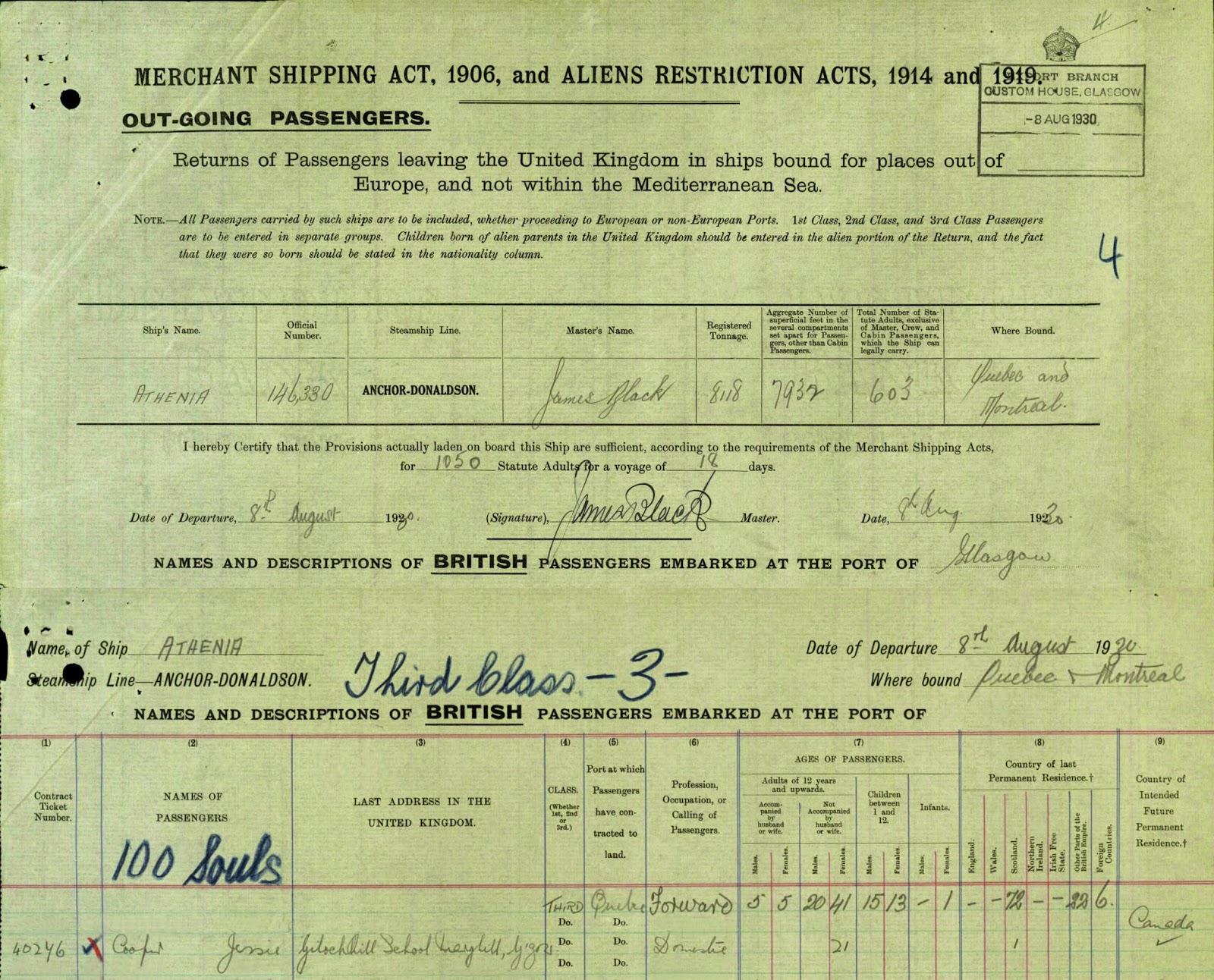
Linda’s mother, and John’s sister, Jessie Walker Cooper, came to Canada four years later, also on the Athenia. She was part of a group of women destined for many parts of Canada most of whom would work in domestic service to pay off their passage. According to the Canadian Immigration Records, Jessie’s final destination was to be the Canadian Women’s Hostel in Calgary, Alberta. Travelling on the same ship were five other women originating in Scotland who were also to be put up in the hostel in Calgary and all of whom were to be employed in domestic positions.
 
Part of passenger manifest for SS Athenia on its voyage from Glasgow to Montreal in 1930; copyright The National Archives (UK) (downloaded from Ancestry 26 October 2008)
John Walker Cooper & Jessie Walker Cooper, Glasgow, ca 1913 (photo from family collection)
Jessie met her future husband, William Alexander McKay, shortly after arriving in Calgary. They were married there 31 July 1931. John Walker Cooper stayed in New Brunswick and married Lillian Marlene McKee on 21 November 1941.

The SS Athenia was built by Fairfield Shipbuilding and Engineering Company, Ltd. and launched om Govan, Scotland in 1923. She was of modest size at 13,456 tons, and could carry 516 cabin-class passengers and another 1,000 in 3rd class. The Athenia was a steam-pwered, twin propeller vessel and could travel at 15 knots. The voyage from Glasgow to Montreal took only nine days. The ship was operated by Anchor-Donaldson Ltd. on its British-Canada route.
 
Photo of SS Athenia in Montreal, Canada harbour – copyright Library and Archives Canada 
(downloaded from Wikipedia 5 June 2014)
The Athenia was the first ship sunk by the Germans at the start of the Second World War. In that respect it has a marked position in history. The attack occurred on 3 September 1939, while the ship was en route from Glasgow to Montreal, 60 miles south of Rockall, Ireland. She carried 1,103 passengers and 315 crew members. Several ships in the area rallied to aid the stricken vessel managing to save all but 117 of those on board. Many of the fatalities happened during the rescue process.

Reports of the sinking made headlines around the globe and the event became a rallying point for support of the Allies and the war against the Nazi regime. Of the sinking itself, the commander, Oberleutnant Friz-Julius Lemp, claimed the ship was travelling “dark” and steering a zigzag course suggesting it was a troopship or armed vessel. He was exonerated by Hitler who decided no public reports should be made about the sinking for political reason.

References:
Janzen, Ed & Susan (Editors). (2012). Canadian Stories, An anthology of British Home Child Stories. Guelph, Ontario: Gentle Edge Publishing Co. Ltd.

Kohli, Marjorie. (2003). The Golden Bridge, Young Immigrants to Canada 1833 to 1939. Toronto, Ontario: Natural Heritage / Natural History Inc.

Wikipedia – SS Athenia    http://en.wikipedia.org/wiki/SS_Athenia

Wayne Shepheard is a volunteer with the Online Parish Clerk program, handling four parishes in Devon, England. He has published a number of articles about various aspects of genealogy and is a past Editor of Chinook, the quarterly journal of the Alberta Family Histories Society. Wayne also provides genealogical consulting services through his business, Family History Facilitated.

Wednesday, 4 June 2014

Passenger Ships – Part 2

In my last post I gave information about how my grandfather arrived in Canada. Other family members also came by ship, some of which vessels had interesting histories themselves.

Name
Relationship
Ship
Date Departed
Date Arrived
Departure Port
Arrival Port
James Shepheard
Great-grandfather
SS Ascania
27 Feb 1913
11 Mar 1913
Southampton
Portland, Maine
 
Portions of the outgoing passenger manifest for the SS Ascania, leaving Liverpool on 27 February 1913 – showing passenger James Shepheard (from Passenger Lists Leaving UK, 1890-1960; copyright The National Archives (UK); image downloaded from FindMyPast 31 May 2014)
The information on the passenger manifests for my great-grandfather, James Shepheard, was quite detailed. In particular, the immigration form listed quite a bit about him and his destination, not all of it entirely correct:
1.      Ticket number – 3196
2.      Name – James Shepheard
3.      Age – 47
4.      Sex – male
5.      Previous visit to United States – no (He had actually visited the US as a crew member on at least one earlier date. His personal bible was shown to have been purchased in New York in 1912 while he was there and working on the SS Usk.)
6.      Occupation – Ship’s Steward
7.      Future permanent residence in Canada – yes
8.      Literacy – could read and write
9.      Nationality – England
10.  Race/People – English
11.  Last permanent address – Cardiff, England
12.  Name and address of nearest relative in country of origin – brother, Cardiff, South Wales
13.  Final destination – Irricana, Alberta (had a ticket to final destination)
14.  Passage paid by self
15.  Carrying $20 in cash
16.  Person to join at final destination – brother, Irricana (It was actually his son, James Pearson, that James was intending to rejoin.)
 
Portions of the incoming passenger manifest for the SS Ascania, arriving Portland, Maine 11 March 1913 – showing passenger James Shepheard (from Atlantic Ports Passenger Lists, 1820-1873 and 1893-1959; copyright National Archives (USA); image downloaded from Ancestry 17 January 2009)
The SS Ascania was built in 1911 by Swan Hunter & Wigham Richardson Ltd. of Wallsend, England and operated by the Cunard Steamship Co. Ltd. The ship was of modest size at 9,121 tons. During the First World War, the ship carried soldiers from Canada and the United States to Europe. She sailed only for a few years, running aground and wrecked on 13 June 1918 in the Cabot Strait, 20 miles east of Cape Ray, Newfoundland. A second ship named Ascania was launched in 1923 and sailed for the Cunard line until its retirement in 1956.
 
Postcard picture of RMS Ascania, circa 1911 (image downloaded from website about Rhiw, Wales www.Rhiw.com 1 June 2014)

Wayne Shepheard is a volunteer with the Online Parish Clerk program, handling four parishes in Devon, England. He has published a number of articles about various aspects of genealogy and is a past Editor of Chinook, the quarterly journal of the Alberta Family Histories Society. Wayne also provides genealogical consulting services through his business, Family History Facilitated.